How Decades of Cost-Cutting, Outsourcing, and Automation Left Customers Stranded With AI Chatbots, and What We Can Do About It
By Stephanie T. Nguyen and Adam Teitelbaum | October 13, 2026
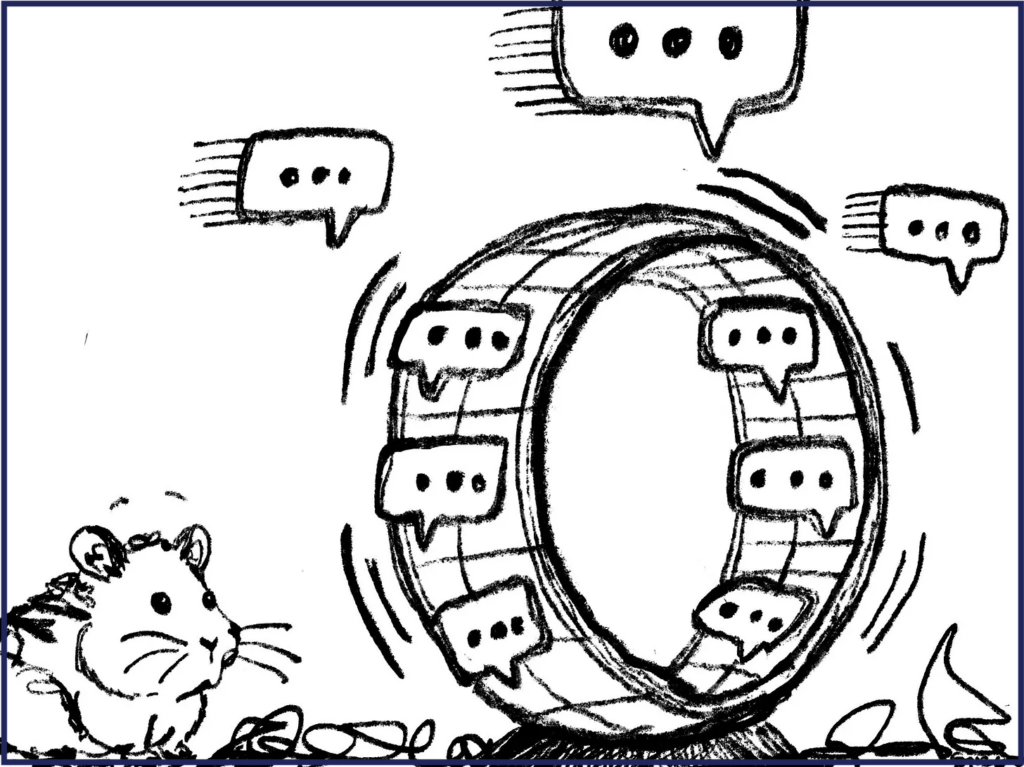
Customer service has been hollowed out and sludged up over the decades.1 Now, in this latest phase, companies are increasingly deploying AI chatbots as the mandatory gateway between consumers and the help they need.2 That includes tenants, borrowers, insurance policyholders, and fraud victims seeking assistance with services that can be enormously consequential in their lives.
While much scrutiny has rightly focused on chatbots as a product, the use of chatbots as an intermediary to get help is a growing area of consumer protection concern. Companies are handing off critical channels for assistance to what can be untested, unreliable AI systems, effectively turning consumers into guinea pigs as those systems are refined through real-world trial and error. The resulting harms take many forms: inaccurate answers, obstructive doom loops or friction-adding features, or a failure to deliver the assistance the service is supposed to offer. Law enforcers and the plaintiffs’ bar can and should use existing law to stop and deter those violations, and all businesses using AI chatbots should take immediate steps to ensure their AI chatbot practices are compliant with consumer protection laws.
Protect Borrowers & Columbia Law School’s Center for Law & the Economy released a compendium of work related to this topic: (1) An issue brief addressing how large corporations—including AI platforms themselves—are deploying AI customer-service chatbots in ways that may violate existing consumer protection laws, along with practical steps enforcers and legislators can take to address the problem; and (2) A scholarly article through Harvard’s Journal of Law & Technology that categorizes the harms these chatbots cause and marshals the existing legal tools and authorities that can be used to address them.
But setting aside the legal analysis, just how did we get here? Each major technological inflection point in customer service has been accompanied by corporate efforts to reduce costs, particularly by decreasing reliance on human labor—and each has moved customers further from anyone accountable for helping them. AI chatbots are the latest chapter in that story, and the earlier chapters help clarify what is strikingly familiar about this moment and what is genuinely new.
To see what has eroded, it helps to start with the baseline. In the early 1900s, customer service was a core tenet to ensure early growth for the brick-and-mortar stores. At the time, retailers who founded their own department stores popularized the notion: “The customer is always right.”3 Sears, Roebuck and Co. vowed that “every transaction would be strictly confidential, that shoppers’ name and address would not appear on any article of merchandise.” Sears also established the “satisfaction guaranteed or your money back” policy.
A look back at the past century of technological evolution reveals a slow demise of this customer-first premise. The history of customer service can be understood in three technological waves—each promising greater efficiency and changing who, or what, stands between a customer and the help they need.4
Centralize and Standardize: The Disappearing Shopkeepers (Early 1900s to 1970s)
The introduction of large distribution channels to people’s homes—like mail-order catalogs, radio, and TV—enabled national brands to market their products and consumer promises. Customers who once engaged face-to-face with a shopkeeper who likely knew them, were now buying from a company whose customer service agents they would never meet, so any problem meant writing to a distant office and waiting for a reply. Toll-free calling then made it practical to answer those problems from a single remote location: AT&T introduced toll-free 800 numbers in 1967, and companies began routing customers toward centralized phone systems for help. In 1973, Rockwell International, an American manufacturing company, developed the “automatic call distributor” to help businesses classify, queue, and route inbound calls. By the 1980s, “Interactive Voice Response” (IVR) automated phone trees—the endless “press 1 for billing,” “press 2 for account” labyrinth—had become ubiquitous, and were positioned as a justification to reduce the need for human agents.
Offshore and Outsource: The Race to Cut Costs (1980s to 2000s)
Beginning in the late 1990s, companies began shipping call centers and jobs overseas to countries like the Philippines and India, prioritizing cost-cutting over investments in customer service—with more than 250,000 call center jobs outsourced between 2001 and 2003 alone. And when companies determined it was simply cheaper to outsource all of their customer support, a vast “middleman” layer of third-party vendors and consultants also emerged to fill the void—leading to less accountability, more errors, and less help to people.
Customer relationship management software like Salesforce, expanded to tackle enterprise-level customer service integration and personalization. Other entrants included Oracle-spinoff company, Siebel Systems, which added customer service applications, along with enterprise software giants like Oracle, SAP, and PeopleSoft, which expanded into customer-facing operations with commercial versions of what were largely their own internal sales applications, in the late 1990s. Many of these vendors then consolidated—making the experiences customers often complain about even worse: long holds, transfers from department to department, and getting caught in automated self-service.
The 2008 Financial Crisis revealed the devastating cost of this half-century of underinvestment: when borrowers most needed access to critical services, decades of neglected customer support left them stranded. A survey by ProPublica found that borrowers had to “submit documents on average six times—but the servicers would still claim the documents had never been received and then foreclose.”
Automate and Deflect: The Rise of the Customer Service Doom Loop (2010s to Present)
The 2010s ushered in a new era of self-service customer support via websites, phone trees, voice prompts, chat, email, and mobile apps. Companies could increasingly use these channels to deflect contact away from live agents, with some even deeming these tactics “sludge” or excess procedural fuss. Customers bear the emotional scars: shouting “representative” or “need something else” to an interactive voice response – repeating a 14-digit account number, or getting trapped in a chatbot that offers the same useless options. Email requests could meet silence or delay: in a 2020 study of 973 consumer-facing companies, 70 percent of those that published an email address never responded, and only 20 percent replied within 24 hours, with replies averaging 36 hours. Company mobile apps could be laced with dark patterns to make it hard to find any way to reach a person. Even amid all this adoption of new technologies, expert researchers recognized that “delighting customers doesn’t build loyalty” and can lead to “confusion, wasted time and effort, and costly giveaways.” Instead, they shared, “all customers really want is a simple, quick solution to their problem.”
AI-powered chatbots might promise to change this, but often simply fail to deliver the help they were deployed to provide. As AI-enabled chatbot agents increasingly act as the primary interface for customer interactions, we are at yet another inflection point. Real people’s lives should not be a testing ground for novel products that can cause harm. Bad AI customer service chatbots can leave consumers facing a range of such harms, including: inaccurate pricing, wrong information, blocked rent payments, unauthorized new cards, higher payments, exposure to fraud, and hours-long waits for assistance. When things go wrong, tech companies say that their products “circumvented controls” or “were misaligned,” as if the systems acted on their own. But these systems are built, deployed, and controlled by people, and blaming the AI is a way to dodge responsibility. People built and enabled it that way.
Do we continue the erosion of customer support, or do policymakers and regulators enforce laws and pass legislation to hold companies accountable and make customer support a core function? As this history shows, new technologies too often left consumers stranded without meaningful help, even as companies grew and bolstered their bottom lines. This is exactly the type of market failure that begs action from policymakers and enforcers. The answer is more robust enforcement against deceptive and unfair customer service practices, no matter the mechanism—including AI chatbots.
###
Adam Teitelbaum is a Senior Fellow at Protect Borrowers, and is the former Director of the Office of Consumer Protection at the Office of the Attorney General for the District of Columbia.
Stephanie T. Nguyen is a Senior Fellow at Columbia Law School’s Center for Law and the Economy and author of the Division of Field Notes. She was the former Chief Technologist at the Federal Trade Commission.
The team is grateful to the expert colleagues and staff who reviewed and contributed to this work, as well as to the many colleagues whose prior initiatives helped inform it: Winston Berkman-Breen, Atur Desai, Douglas Farrar, Seth Frotman, Hannah Garden-Monheit, Eric Halperin, Lina M. Khan, Min Su Kim, Brad Lipton, Erie Meyer, Sarah Miller, Maxwell Niles, Mike Pierce, Lorelei Salas, and Abby Etta Smith.
This post by Stephanie Nguyen and Adam Teitelbaum was also published at the Division of Field Notes, a Substack on the changing role tech plays in our lives, and In Debt, a Protect Borrowers Substack.
Endnotes:
- Sludge refers to burdens, obstacles, and friction that companies put between consumers and the help they need. ↩︎
- For simplicity, we use “chatbots” throughout this piece to refer to these interfaces, which can include, for instance, automated voice assistants, AI-guided forms or workflows, and chatbots on websites, apps, or search engines. ↩︎
- Retailers include John Wanamaker (historic department store in Philadelphia), Marshall Field (owner of Marshall Field and Company in Chicago), and Harry Gordon Selfridge (founder of Selfridges in the UK). ↩︎
- This overview is not meant to be a comprehensive historical account; it aims to generally describe the core trends of the past century. ↩︎