As Midterm Elections Put Medical Debt Relief on the Ballot, State Lawmakers Aren’t Waiting for Washington to Act
By Elena Botella | October 1, 2026
Earlier this month, we shared the bombshell New York Times story that Senator Roger Marshall (R-KS), an obstetrician-gynecologist, sued more than 700 of his patients for allegedly unpaid medical bills. Senator Marshall sought and won garnished paychecks, warrants, and jail time for women recovering from childbirth, miscarriages, and emergency hysterectomies.
Economist Neale Mahoney, speaking to the Times (and again with more detail on Twitter), said that Senator Marshall’s litigation strategy was more aggressive than the norm.
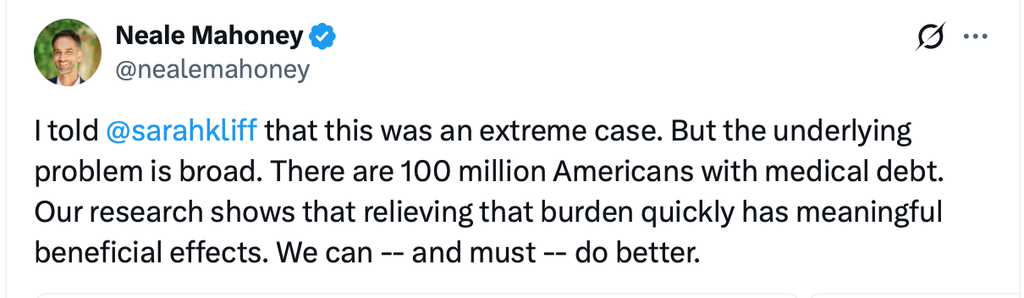
But Marshall’s patients are far from alone. People all over the country are crushed by medical debt, facing collection lawsuits, garnished paychecks, ruined credit, and mounting bills for care they needed to survive.
The Marshall story shows this isn’t a private issue: for-profit healthcare providers depend on our court system’s public infrastructure to seize money from patients. In many states, laws let private hospitals send bills to collections while insurance decisions are still pending, garnish wages, and even foreclose on patients’ houses.
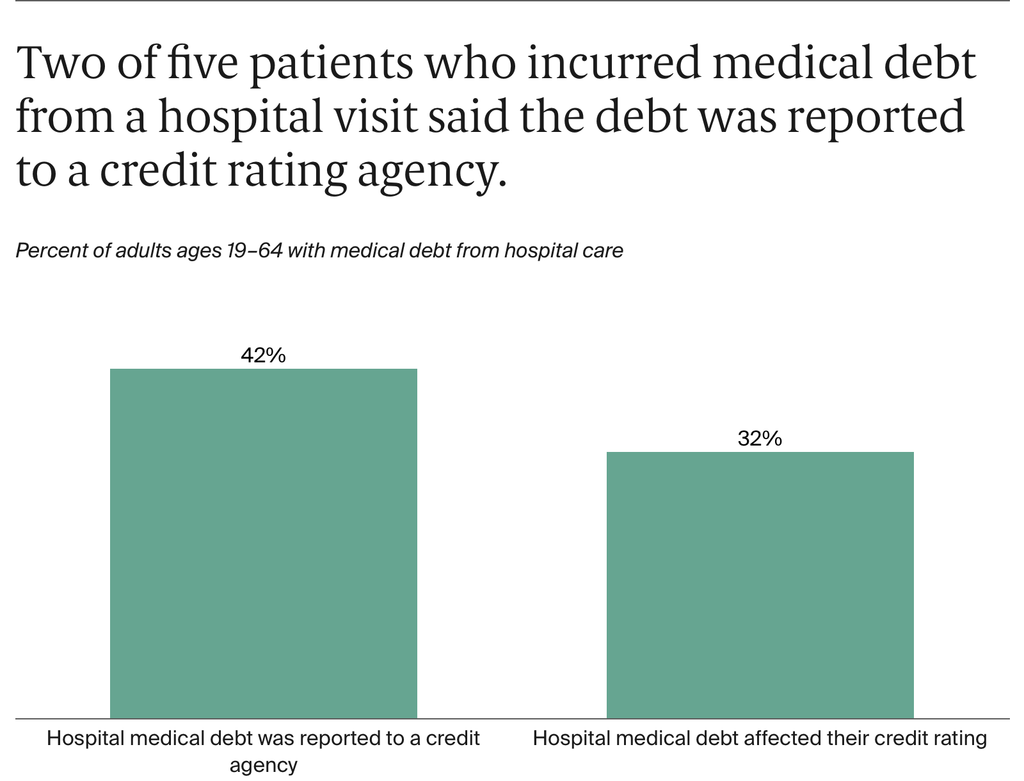
Credit reporting is the quieter version of the same threat. Hospitals and debt collectors don’t need a lawsuit or a court order to hurt you — they report your unpaid bill to Equifax, Experian, or TransUnion, and let your credit score do the damage for them. A survey by the Commonwealth Fund found that 42% of people with unpaid medical bills from a hospital visit had that debt appear on their credit reports. Medical debt on a credit report means sick people pay the cost of their illness twice: once for the original medical bill, and again every time a landlord, insurer, or phone company checks their credit and charges them more because of their credit history.
The burden of medical debt is especially crushing for people who are seriously ill. In moments when people are struggling to survive, their debt becomes a second disease. The American Cancer Society found that high proportions of cancer patients were harassed by creditors and collection agencies and reported that debt worsened their physical and mental health.
It doesn’t have to be this way.
There’s a growing movement to reform the state laws that push patients into financial crisis.
Since 2021, New Mexico, Colorado, New York, Delaware, Maryland, Maine, Virginia, and the District of Columbia have curtailed wage garnishment for medical bills, mandated that healthcare providers offer reasonable payment plans, and made it easier for ordinary people to get unaffordable bills cancelled before they ever see a courtroom. Three of these bills, in Maine, Virginia, and D.C., either passed or went into effect this year. And since 2023, 15 states and D.C. have passed legislation to keep medical debt off credit reports. The Consumer Financial Protection Bureau (CFPB) was set to do the same nationwide, finalizing a rule in January 2025 that the Trump Administration helped to kill just a few months later.
Medical debt will never be fair — but state and local governments are responding to public pressure by passing laws that shut down the most abusive collection tools and create more humane alternatives.
Take D.C.’s Medical Debt Mitigation Amendment Act, which became law on August 20, 2026. It bundles together:
- Limiting the ability of medical debt collectors to garnish wages and place home liens. Anyone earning under 500% of the federal poverty level — about $78,000 for a single person or $165,000 for a family of four — can’t have their paycheck garnished or a lien placed on their home over unpaid medical bills.
- Slowing down collections. Providers must wait at least 180 days after the first bill before they can start collections. That gives patients more time to challenge billing errors and insurance denials.
- Banning medical debt from credit reports. Hospitals and debt collectors can no longer report medical bills to Equifax, Experian, or TransUnion — so a hospital stay won’t tank your ability to rent an apartment or buy a car.
- Capping interest at 3%. Senator Marshall’s patients’ debts grew at an 18% interest rate. Under the D.C. law, medical debt won’t snowball as quickly.
- Requiring discounted care on a sliding scale, with financial assistance policies that make sense. While non-profit hospitals across the country are theoretically required to offer financial assistance to their lowest-income patients, the application processes are often hidden, the eligibility confusing, and the policies incredibly stingy. Hospital chains are raking in tax breaks, while expecting families making just $40,000 or $50,000 a year to cough up thousands of dollars they simply do not have. D.C.’s law establishes simple and (relatively) clear eligibility standards: it requires free care to patients with an income below 200% of the poverty line, and discounted care to patients with an income below 500% of the poverty line.
- Requiring discounted care to be coupled with reasonable payment plans. Hospitals will be required to offer low- and middle-income patients payment plans with payment amounts capped at 3% of monthly income. Any amount remaining on the payment plan at 36 months is forgiven.
- Cracking down on medical credit cards. Hospitals can’t push patients into medical credit cards or loans before checking whether they qualify for financial assistance first.
But change is patchy, even in the states that have passed major legislation. Exactly which patients are protected from wage garnishment and foreclosure varies wildly from bill to bill. Only five states — Delaware, New York, North Carolina, Pennsylvania, and Texas — have banned wage garnishment for medical debt altogether. And in D.C. and most of the other states with new protections, only the government can sue a medical provider for breaking the law – patients themselves can’t sue to enforce their rights, making noncompliance more likely.
Perhaps not surprisingly, opponents are doing whatever they can to roll these protections back. In 2025, Trump’s hijacked CFPB published an interpretive rule saying the federal Fair Credit Reporting Act preempts states from banning credit reporting of medical debt. In other words, the CFPB is arguing that these state laws are illegal — that they conflict with federal law and therefore can’t be enforced, no matter what a state legislature or governor says. Their interpretive rule isn’t legally binding – it’s just the agency’s opinion – but debt collectors can use it as ammunition when they challenge state laws. Debt collectors in Colorado have filed a lawsuit challenging the state’s medical debt credit reporting ban, not only on preemption grounds, but also claiming they have a First Amendment right to tell the world that your neighbor hasn’t finished paying for her hysterectomy. Let freedom ring, I guess.
The public overwhelmingly supports reining in predatory medical debt practices and keeping medical debt off credit reports.
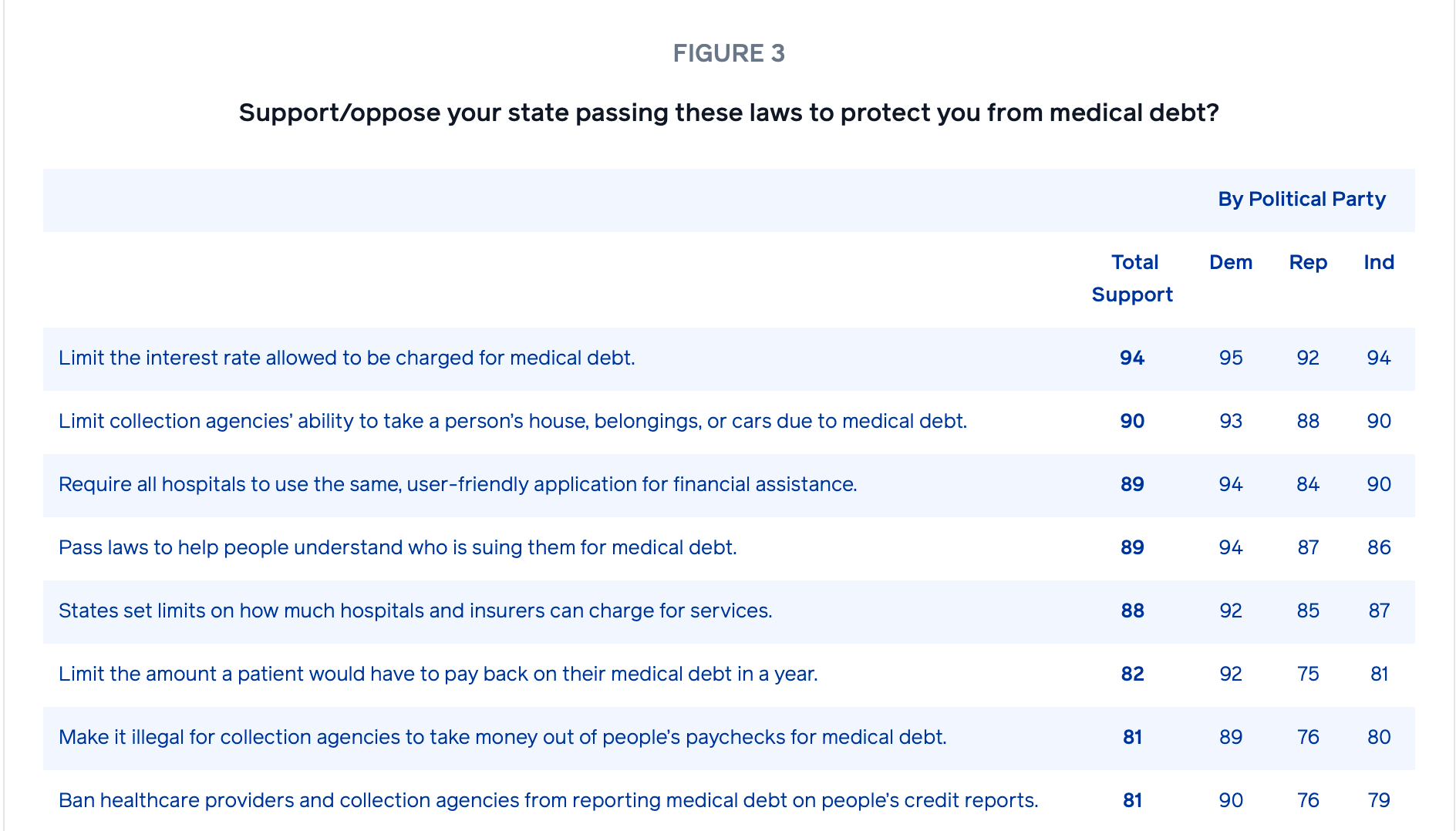
Despite the industry pushback, nearly everyone agrees that getting sick shouldn’t lead to financial ruin. Recent polling shows 81% of voters support banning medical debt from credit reports. Ninety-four percent of voters believe states should limit the interest rate allowed for medical debt, and 90% want to see limits on collection agencies’ ability to take a person’s house, belongings, or cars due to medical debt. This goes way beyond bipartisan support … it’s basically everyone, and an opportunity for lawmakers to protect our physical, mental, and financial health from the ruinous burden of medical debt.
###
Elena Botella is a fellow at Protect Borrowers. She is a former Senior Manager at Capital One, and the author of Delinquent: Inside America’s Debt Machine (University of California Press: 2022). Elena holds a bachelor’s degree from Duke University and is earning a J.D. from Georgetown University Law Center. This blog was also published on In Debt, a Protect Borrowers Substack.