Prediction markets have built billion-dollar businesses on integrity promises they cannot keep. State AGs have the tools to do something about it.
By Adam Teitelbaum | July 9, 2026
You’ve almost certainly heard of prediction markets by now. Maybe you placed a bet during the 2024 election. Maybe you watched someone clean up on a Super Bowl wager. Maybe you just saw the headline: Kalshi, the dominant U.S. prediction market platform, recently raised $1 billion at a $22 billion valuation. Users globally now spend more than $5 billion every week on platforms like Kalshi and its main competitor, Polymarket.
The selling point is simple and genuinely appealing. Unlike a sportsbook or a casino, you’re not playing against the house. You’re trading against other people—real people putting real money behind their real beliefs—on questions that actually matter: elections, interest rate decisions, geopolitical events. The price you see reflects the crowd’s collective wisdom. The playing field is level. Prediction markets, as Kalshi’s CEO has put it, are “quintessential truth machines”—“the most accurate thing we have as mankind right now.”
There’s just one problem. That whole premise is, at best, wildly misleading. And the evidence is piling up. Fortunately, enforcers have the tools to do something about it.
The Pitch: Stricter Than the Stock Market
Let’s take Kalshi as an example. It has built its entire brand around the integrity and fairness of its markets—for a reason: Kalshi earns a fee on every trade, so attracting users, and keeping them, requires convincing them the platform is trustworthy. As Kalshi acknowledges: “Our philosophy is simple: if the markets are not safe, no one will trade on them. It is a business imperative, and core to the identity of Kalshi, for all of our markets to operate with maximum trust, safety, and oversight.”
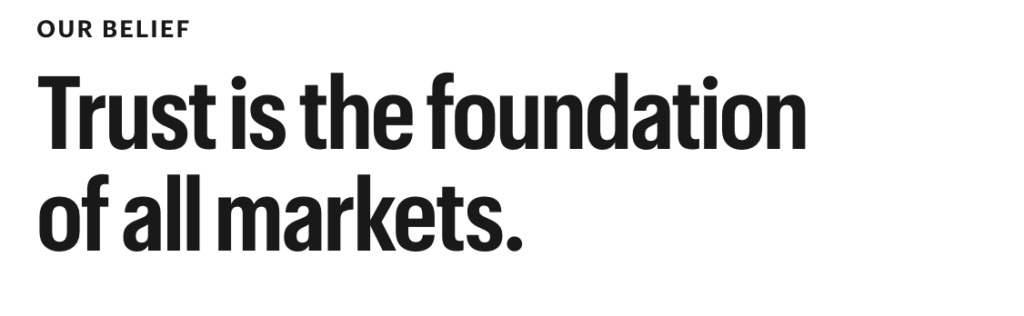
Kalshi’s website is peppered with flashy marketing pages and blog posts highlighting its efforts to ensure integrity and combat insider trading. The company creates the strong impression that few (if any) violations slip through the cracks—an impression it buttresses by touting its surveillance technology, offering several examples of “bad actors” caught by Kalshi’s enforcement efforts, underscoring its “200+ investigations” opened, and listing a series of experts advising the company on integrity issues.
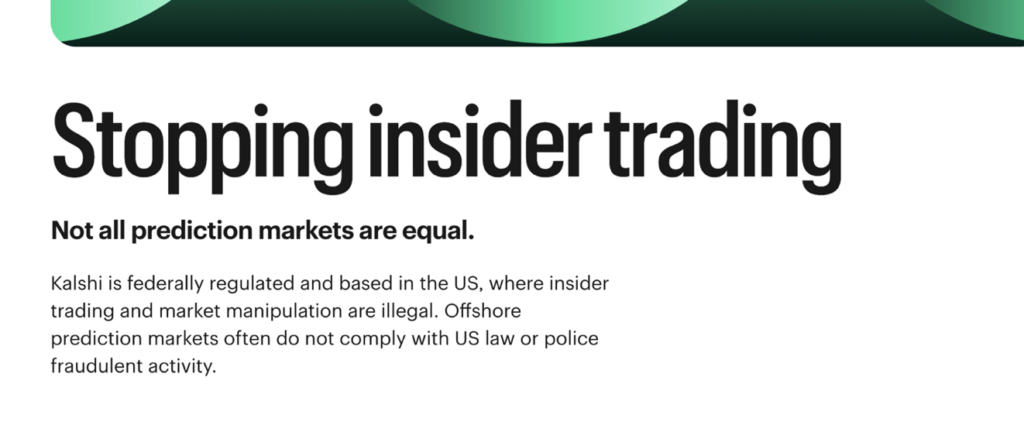
But Kalshi doesn’t just claim to be fair. It claims to be fairer than Wall Street. From the company’s own website:
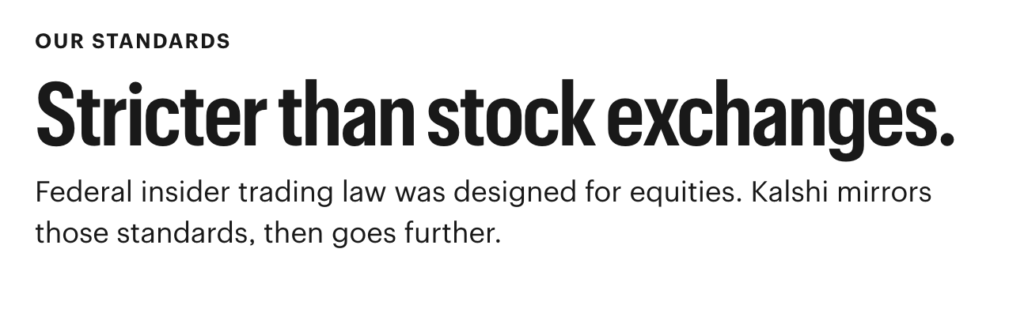
Kalshi repeatedly compares itself favorably to regulated financial markets—for example, highlighting its “integrity and surveillance monitoring [that] not only meet, but also go beyond … what is federally prohibited for securities trading.” Kalshi even equates its regulator—the Commodity Futures Trading Commission (CFTC)—with the SEC, while suggesting that commodities markets are governed by rules similar to those that apply to financial markets.
This is not fine print. These aren’t buried disclaimers. These are the company’s loudest selling points, plastered across its website, repeated in executive interviews, trumpeted in press releases. Kalshi has built its business on these promises. And they are promises the company cannot keep.
The Headlines Tell a Different Story
Here’s what we know just from public reporting.
In February 2026, Kalshi disclosed that it had fined and suspended Artem Kaptur—an editor at MrBeast, one of YouTube’s biggest channels—for trading on inside knowledge of content before it went public. Around the same time, it disciplined Kyle Langford, a former California gubernatorial candidate who had traded on his own publicly announced plans. These are the cases Kalshi caught (and publicized): the low-hanging fruit—people whose connection to inside information was hiding in plain sight.
Now consider what happened around the 2026 Super Bowl. A single trader placed $500,000 on Lady Gaga appearing at halftime before any public confirmation. The NFL itself flagged over $47 million in trading on announcer mention markets as structurally vulnerable to insider trading, requesting the platform to refrain from allowing these contracts. A Wall Street Journal investigation revealed that college students were trading on tips circulating through fraternity group chats about celebrity appearances. Kalshi has disclosed no enforcement actions arising from any of it.
Most recently, former Congressman George Santos allegedly placed bets predicting he would not attend President Trump’s State of the Union address—while publicly declaring on social media that he would be in the gallery. He didn’t show up. The DOJ and CFTC opened investigations only after the fact.
In just the first quarter of 2026, Kalshi reportedly flagged more than 400 suspicious trades—more than twice the number it investigated in all of 2025. The problem isn’t being solved. It’s accelerating.
And that’s just what we know from what little we can see. A recent academic study estimated that on Polymarket, Kalshi’s primary competitor, there were $143 million in anomalous profits across more than 210,000 suspicious trades. While Polymarket has plenty of its own faults, its blockchain architecture has the benefit of making every trade publicly visible—meaning researchers and investigators can actually see the problem. Kalshi’s trade data is entirely opaque. We have no idea what we’re not seeing.
But could these just be bad actors who slipped through the cracks of an otherwise robust system? Are we being unfair to Kalshi?
[Note: shortly before publication, our friends at the Roosevelt Institute published a new study looking at a set of Kalshi’s transaction data that was briefly—but is no longer—available to the public. Rather than look at suspicious trades, they looked at so-called “market makers”—the big institutional traders that add billions of dollars in liquidity to Kalshi’s market. They found that these traders act as “the House”—betting with an edge that produces windfall profits for them and losses for the vast majority of regular people.]
The Problem Isn’t the Bad Actors. It’s the Platform.
The incidents above are not isolated failures of an otherwise functioning enforcement system. They are symptoms of something structural—a problem that is baked into the product and cannot be fixed by hiring more compliance staff or building a fancier surveillance algorithm.
Think about who counts as an “insider” on a stock exchange. It’s a finite, well-defined group: executives, directors, and their lawyers and bankers. The SEC knows who they are before they trade. They have to file disclosures. Now think about who counts as an “insider” on Kalshi. Kalshi lets users bet on essentially anything: Fed rate decisions, election results, military operations, earnings announcements, celebrity appearances, Super Bowl halftime shows. The list is endless, meaning the universe of potential insiders is as well—making proactive surveillance near impossible. To make matters worse, potential insiders include the government officials, military officers, and elected representatives whose non-public information is not just market-moving but potentially the product of public trust.
That’s not just an insider trading problem; it’s a corruption problem.
The legal landscape compounds the challenge. Kalshi assures its users that “the question of whether insider trading applies to prediction markets is a relatively simple one” and that “the answer is clear: yes, it does.” It isn’t, and (in many cases) it doesn’t. The CFTC’s own regulations explicitly allow trading on lawfully obtained material non-public information in commodities markets. The CFTC’s Director of Enforcement acknowledged in March 2026 that insider trading liability attaches only when someone breaches a pre-existing duty to the source of their information—a far narrower standard than the one governing securities markets. A celebrity’s publicist who bets on an appearance announcement before it’s made public may not be violating any law at all.
Finally, the CFTC is compromised and toothless—Kalshi’s assurances notwithstanding. Rather than directing the CFTC to vigorously police these platforms, the Trump Administration has weaponized it to do just the opposite: suing states that are trying to regulate prediction markets under state law. Perhaps this should be no surprise, as Donald Trump, Jr. is a “strategic advisor” to Kalshi and sits on Polymarket’s advisory board. And while Kalshi claims the CFTC is no different than the SEC, the reality is that the CFTC “is broadly understaffed,” with less than one sixth of the budget and one seventh of the staff of the SEC. Between October and December 2025, the CFTC filed one enforcement case, compared to 29 by the SEC in the same period.
The upshot of all of this: Kalshi is lying. It cannot make good on its fairness and integrity promises.
What State AGs Can Do—The Case Nobody Has Made Yet
State attorneys general have been far from passive. More than 15 states have sued or issued cease-and-desist orders against Kalshi, and their actions have drawn national attention. But each of those enforcement efforts has focused on the same theory: that Kalshi’s sports contracts constitute illegal gambling under state law. That theory has hit serious headwinds. Courts have split sharply on whether federal commodities law preempts state gambling regulation—and the CFTC’s aggressive intervention in these cases hasn’t helped matters.
But the facts above support a potentially more powerful theory. Rather than focusing the debate on “is this gambling?” the question becomes: “did Kalshi lie to and take advantage of its customers?”
That question has a clearer answer. And it points to one of the most powerful tools in any AG’s toolkit: UDAP authority.
UDAP—Unfair, Deceptive, (and, in some states, Abusive) Acts and Practices—statutes exist in every state. They prohibit businesses from lying to consumers, taking unfair advantage of them, or exploiting their inability to protect themselves. They don’t turn on whether Kalshi’s contracts are gambling. They turn on whether Kalshi’s promises about market integrity were false and misleading—and whether the company’s business model exploited consumers who had no way of knowing the truth.
AGs have used UDAP authority to hold some of the most powerful industries in the country accountable: the opioid manufacturers who told patients and doctors their drugs weren’t addictive, the vaping companies that marketed their products to teens, and the social media companies that told parents their platforms were designed for kids’ wellbeing.
The remedies are powerful. AGs can seek: (1) court orders requiring Kalshi to prominently disclose the real risks of its marketplace to every user, or to provide stronger guardrails on its platform; (2) refunds of fees it collected from consumers who traded on an unfair and deceptive platform; and (3) civil penalties for every single transaction tainted by Kalshi’s unlawful conduct. On a platform processing billions of dollars in trades, the exposure is enormous.
Preemption? That’s where the UDAP theory is genuinely stronger than the gambling theory. Courts have consistently recognized that state consumer protection laws targeting what a company says to consumers are different in kind from state laws trying to regulate how a federally licensed market operates. As a law of general applicability, a state’s UDAP law should apply to a prediction market’s claims, even if that same state’s gambling law is preempted. And AGs can potentially sidestep the preemption question entirely using their enforcement authority under the federal Consumer Financial Protection Act—which isn’t subject to the Commodity Exchange Act’s preemption provisions at all.
The Window
Prediction markets are young, fast-growing, well-connected – and currently operating in a regulatory vacuum. The window to establish meaningful consumer protection guardrails in the industry—before it gets too big, too entrenched, and too politically fortified to hold accountable—is open right now.
Lawmakers are ill-suited to meet this moment: partisan divides and industry capture in Congress make it unlikely to legislate prediction markets in any meaningful way, and the preemption concerns discussed above leave state legislatures with little authority.
Existing UDAP laws, however, stand ready to meet this moment. Prediction markets offer a product that is structurally susceptible to insider trading and manipulation and nearly impossible to meaningfully police, all while making sweeping integrity assurances that are deeply misleading at best, and flatly false at worst. A case resting on the premise that these “new” practices are, in fact, the same unfair, deceptive, and abusive practices that resulted in the enactment of the first UDAP laws nearly 100 years ago would be the first of its kind—and industry actors have given every AG in the country more than enough reason to bring it.
###
Adam Teitelbaum is a Senior Fellow at Protect Borrowers. He is the former Director of the Office of Consumer Protection at the Office of the Attorney General for the District of Columbia.
This blog was also published on In Debt, a Protect Borrowers Substack.