22 Questions for Treasury Secretary Scott Bessent
By Mike Pierce and Aissa Canchola Bañez | March 19, 2026
Last night, POLITICO reported that the U.S. Department of Education (ED) and the U.S. Department of the Treasury (Treasury) inked a new agreement to relocate key financial services functions from ED’s Office of Federal Student Aid (FSA) to Treasury. Rebecca Carballo explained:
“Education Department would shift its responsibility for handling student loans in default to Treasury via an interagency agreement similar to the ones that the administration has already used to transfer education responsibilities to other agencies.”
This is part of billionaire GOP mega donor-turned-ED Secretary Linda McMahon’s ongoing scheme to dismantle ED. At first blush, this appears to be more political theater, but it may also have real-world consequences for borrowers who fall through the cracks of our broken student loan system far too often.
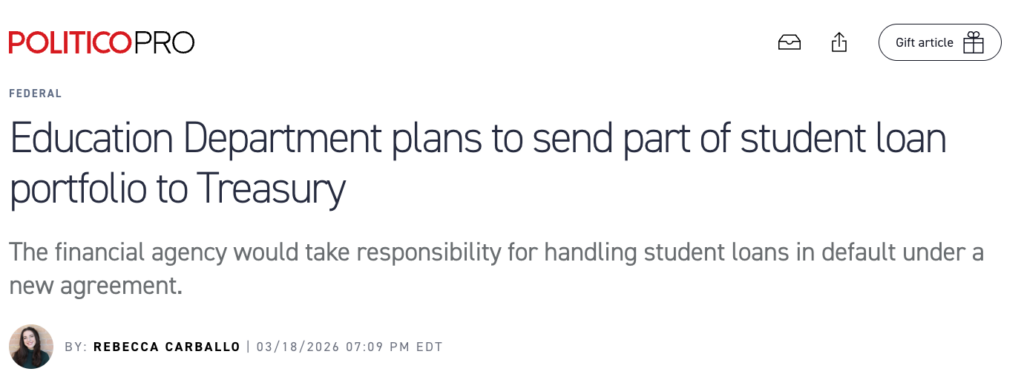
According to Carballo’s reporting, Treasury would handle collections on about $180 billion in defaulted federal student loans, owed by 7.7 million student loan borrowers. Since taking office in January of last year, President Trump has overseen the largest wave of student loan defaults in the 60 year history of the federal student loan program—more than 3.6 million Americans with student loans fell behind by nine months or more over that period. Over the first year of the Trump Administration, a new borrower fell into default every 9 seconds.
The Trump Administration’s approach to defaulted student loans remains erratic—split between hard-core right wingers like the Education Secretary who want to see borrowers pay up and a President who seems to have no interest in being ‘America’s Debt Collector-in-Chief.’ As we reported earlier this year, in response to the growing affordability crisis, ED abandoned plans to resume wage garnishment and other forced collections. As the midterms approach, President Trump continues to face strong political headwinds due to rising costs and the Administration’s ongoing failure to respond to voters’ affordability concerns.
By any measure, the historic wave of student loan borrower defaults is a black eye for an Administration that pretends to care about making America affordable again. It’s clear why Secretary McMahon would want to be rid of this political albatross. It is a mystery why Treasury Secretary Bessent would want to clean up McMahon’s mess.
One former regulator and congressional staffer who has worked on student loan issues for over a decade said this move “just feels like a huge shit sandwich for Scott [Bessent].”
We have 22 questions for Bessent.
Here are 22 questions for Treasury Secretary Bessent, on the occasion of one of the strangest examples of bureaucratic buck-passing in living memory.
- Under Secretary McMahon’s watch, ED has damaged the credit of more than 8 million Americans in the past 15 months, doubling the cost of other types of credit and locking these families out of the conventional mortgage market. Does Secretary Bessent agree with this decision?
- Is the removal of ED’s operational responsibility for collecting on defaulted student loans a critique of ED’s decision to damage the credit of more than 8 million Americans?
- How much will it cost the United States to change the name of the agency responsible for handling student loans on all of the branding for the student loan program, including required notices sent to borrowers?
- Does Secretary Bessent agree that private collection agencies hired by the federal government must comply with the Fair Debt Collection Practices Act (FDCPA)?
- Does Secretary Bessent agree that all Treasury personnel and contractors must comply with the Fair Credit Reporting Act (FCRA)?
- Does Secretary Bessent agree with Acting Consumer Financial Protection Bureau Director Russ Vought’s decision to deprioritize independent oversight over the student loan market, including enforcement of the FDCPA and FCRA to protect borrowers with defaulted federal student loans?
- Two weeks ago, the U.S. Government Accountability Office found that FSA was not performing routine oversight over the government contractors that provide financial services to borrowers with student loans. It raised warnings about the quality and accuracy of customer service. Will Secretary Bessent immediately fire ED’s student loan contractors once it takes responsibility for collecting on defaulted student loans?
- Under Secretary McMahon’s watch, ED has allowed 3.6 million people to slide into default. Historically, borrowers in default have had income low enough to qualify for a $0 monthly loan payment, but have not been able to invoke this right due to government mismanagement and student loan industry misconduct. Does Secretary Bessent agree that this is a failure of government, not a failure by borrowers?
- The Debt Collection Improvement Act requires that federal agencies using the Treasury Offset Program must certify that the debts they seek to collect are, among other things, legally enforceable. How does Treasury plan to ensure that the 8.8 million loans more than 270 past due are legally enforceable?
- Where a borrower in default has been harmed by ED officials’ incompetence, does Secretary Bessent believe it is appropriate to seize these borrowers’ tax refunds?
- Where a borrower in default has been harmed by ED officials’ incompetence, does Secretary Bessent believe it is appropriate to seize these borrowers’ wages?
- Where a borrower in default has been harmed by ED officials’ incompetence, does Secretary Bessent believe it is appropriate to seize these borrowers’ Social Security checks?
- Where a borrower in default has been harmed by misconduct by one of ED’s student loan contractors, does Secretary Bessent believe it is appropriate to seize these borrowers’ tax refunds?
- Where a borrower in default has been harmed by misconduct by one of ED’s student loan contractors, does Secretary Bessent believe it is appropriate to seize these borrowers’ wages?
- Where a borrower in default has been harmed by misconduct by one of ED’s student loan contractors, does Secretary Bessent believe it is appropriate to seize these borrowers’ Social Security checks?
- When homeowners must navigate a transfer between mortgage servicers, companies are prohibited from reporting negative information to credit reporting agencies in the aftermath. Will Treasury and ED follow these same guidelines for student loan borrowers?
- How long do you expect this transition to take?
- Will borrowers be notified of this transition?
- Will borrowers be able to make voluntary payments on defaulted loans during this transition?
- Will the student loan contractors handling servicing and collection on defaulted loans change as a result of this transition?
- For borrowers with loans in default, will borrowers’ wages be garnished during this transition?
- For borrowers with loans in default, will borrowers’ tax refunds be seized during this transition?
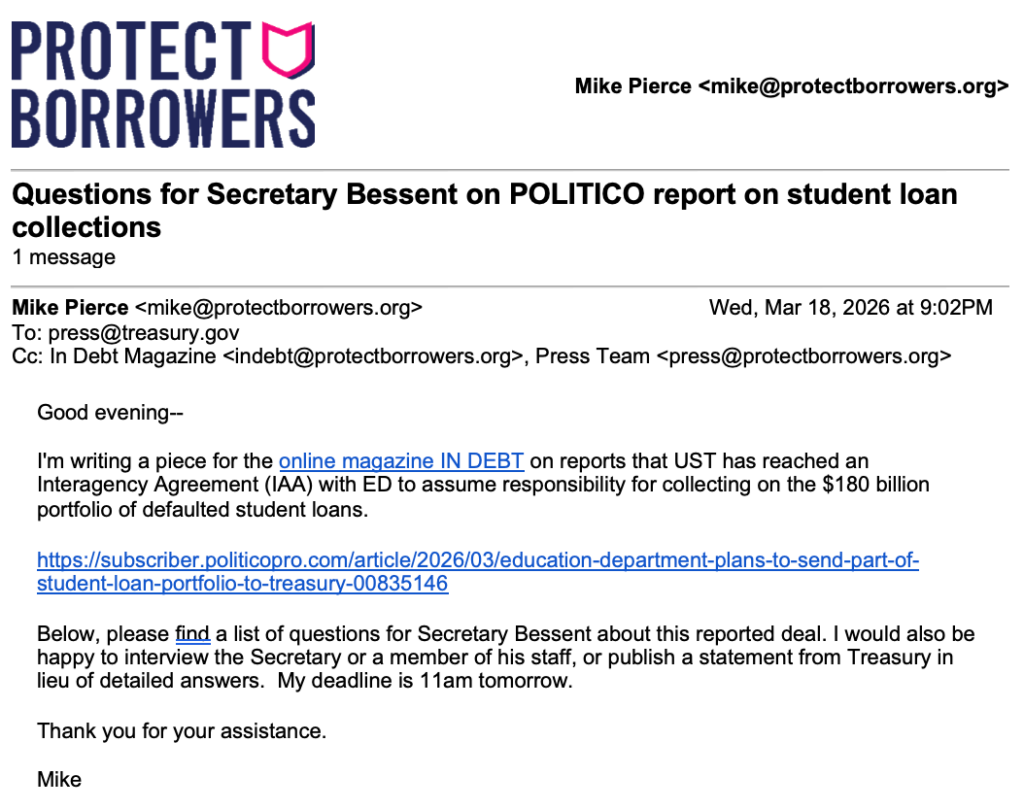
Last night, we shared this list of questions with the press team at Treasury. As of the time of this publication, we had yet to receive a response.
Maybe Congress will have more luck.
###
Mike Pierce is the Executive Director and co-founder of Protect Borrowers.
Aissa Canchola Bañez is the Policy Director at Protect Borrowers. Previously, Aissa led outreach and engagement efforts for the Office for Students and Young Consumers at the Consumer Financial Protection Bureau and served in senior policy roles in the U.S. House of Representatives and U.S. Senate.
This blog was also published on In Debt, a Protect Borrowers Substack.