Why the POWER Act Can Deliver in Ways That Government Alone Never Will
By Winston Berkman-Breen and Mike Pierce | October 8, 2026
Today’s Substack by Winston and Mike offers their take on the introduction of the POWER Act in New York City. The bill now before the New York City Council has its roots in a paper Winston wrote earlier this year as part of Affordable NYC Now, a joint project by Protect Borrowers and The Century Foundation to advance policies in New York City that lower costs for New Yorkers and hold corporations accountable.
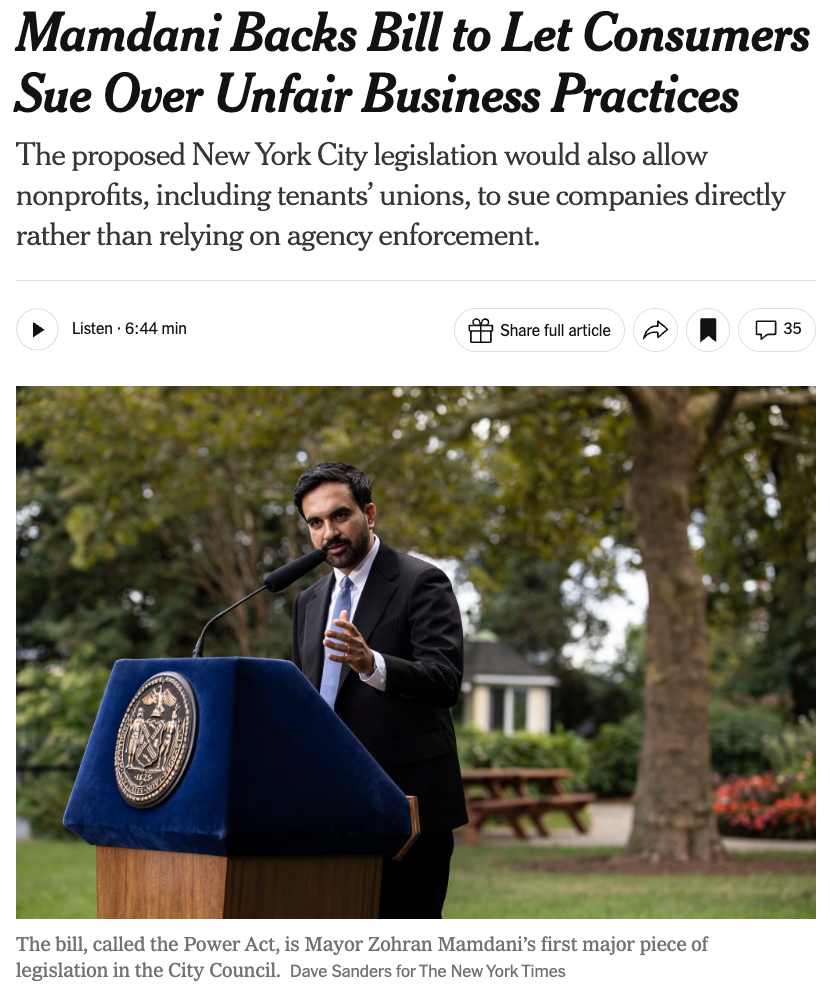
This week, New York City Mayor Zohran Mamdani sent “his first major piece of legislation” to the New York City Council. The POWER (People and Organizations Winning Economic Relief) Act will be championed in the council by Councilmember Harvey Epstein, chair of the Committee on Consumer and Worker Protection, who also spent years in Albany fighting to expand New Yorkers’ right to hold corporations accountable.
The POWER Act does something that is both simple and radical at the same time: it gives New Yorkers, including consumers, workers, tenants unions, and small businesses, the authority to enforce existing law against the big corporations that treat them unfairly.
The POWER Act creates what is called a “private right of action” for New Yorkers. All manner of laws already offer this right to people affected by businesses’ conduct across the economy. Workers can sue bosses for wage theft under the federal Fair Labor Standards Act. Consumers can sue debt collectors for treating them unfairly under the federal Fair Debt Collection Practices Act. Closer to home, New Yorkers can sue businesses that lie to them, directly enforcing New York state’s ban on deceptive trade practices.
This is a critical, if poorly understood, aspect of how a democracy should work: lawmakers pass laws that ban things the public finds unacceptable—wage theft, unfair debt collection, deceptive business practices—and then empower all of us to keep corporations honest.
The bar for regular people to challenge abuses by corporations is high. To have “standing” to sue—the ability to file a case in court—typically someone must prove that they were hurt by an unlawful practice, not merely that the company broke the law. That means private individuals must subject themselves to the time, expense, and scrutiny of being a plaintiff. Filing a lawsuit isn’t easy and the legal system typically doesn’t let us outsource this role to parties who are up for the task.
Over time, the courthouse doors started to close even when people had the evidence and will to challenge corporate lawbreaking—fine print in contracts between people and companies increasingly include clauses that waive the right to sue up front, forcing anyone who wants to hold a company accountable to do so in a secret administrative proceeding known as “arbitration.” Volumes have been written about how the rules of arbitration are stacked in favor of the corporations that constructed this shadow justice system. There is broad consensus among experts, advocates, and lawmakers that arbitration denies access to justice for many people much of the time.
Who does the POWER Act empower?
The POWER Act has a clever answer for corporations that would love to keep evidence of their abuses contained to secret arbitration proceedings, far out of the public eye. If passed, the POWER Act would give standing to labor unions, tenants unions, and other nonprofit organizations to hold companies accountable directly for harm to the general public. These litigants must still prove that someone has been injured by the company’s abuses but, because these organizations never signed a contract with a lawbreaking corporation, they cannot be kicked out of court and forced into arbitration.
It is clearly in the public interest to ensure corporations cannot break the law with impunity and the POWER Act does exactly that. For example, a tenants association can sue a corporate landlord for charging residents junk fees, without an individual resident having to bear the burden of being a plaintiff in the case. Similarly, a labor union can sue an employer that uses predatory (and illegal!) stay-or-pay clauses to trap employees in modern indentured servitude without putting the burden on an individual union member to take her employer to court.
You may have noticed that in our description, we said nothing about expanding the powers of Mayor Mamdani’s administration—the POWER Act doesn’t. Should the City Council pass this groundbreaking piece of legislation, New York City government’s consumer and worker protection toolbox will remain the same. What the bill does, in addition to empowering private litigants, is effectively deputize civil society, like the associations and unions described above, to act as private attorneys general—expanding the number of actors enforcing the law on behalf of all of us.
Democracy, Power, and Economic Populism
The POWER Act is as much about democratic accountability as law enforcement. Even when our elected officials pass laws to rein in corporate criminals, these same corporations still use their money and influence to escape justice. This is page one of the corporate lobbyist playbook and we have seen it on full display in state legislatures across the country in recent months.
For example, earlier this year and at the 11th hour, lobbyists for Big Tech inserted a provision in Maryland’s first-in-the-nation ban on some surveillance pricing tactics that cut off shoppers’ right to enforce not only this new ban, but also existing state consumer protection laws. This let lobbyists claim they were on customers’ side while knowing that companies gouging consumers could bank on public enforcers’ limited resources to escape justice most of the time.
We saw the same story play out in California, as lobbyists persuaded lawmakers to eliminate any mechanism for small businesses or consumers to enforce the new antitrust law signed by Governor Newsom last week—and while they were at it, they also used this new law to limit private enforcement of the state’s existing ban on certain kinds of unfair competition.
Councilmember Epstein and Mayor Mamdani understand the power of corporate influence and the corrosive effect it has on our democracy. This is a unifying principle behind much of what New York City has done this year to hold corporations accountable for cheating workers, tenants, and families. Elections have consequences, as they say. The POWER Act is one of them.
###
Winston Berkman-Breen is legal director at Protect Borrowers. Mike Pierce is executive director at Protect Borrowers. This blog was also published on In Debt, a Protect Borrowers Substack.