Searching for a “Win-Win” on Credit Card Rates Misses the Point
By Mike Pierce | August 11, 2026
[Ed. Note: This article was also published at Open Banker, an online publication about financial policy.]
My former CFPB colleague Alexei Alexandrov penned an interesting piece for Open Banker proposing a new “off ramp” for families experiencing debt stress, offering this new option as an alternative to a mandatory, universal cap on credit card interest rates. Alexei’s idea is creative and would solve a real problem for a certain set of Americans. Maybe it is a true win-win — a way for financial institutions to lower the economic strain on struggling customers while continuing to earn revenue. This rationale isn’t too different from the case for a Great Recession-era mortgage modification or income-driven student loan payments.
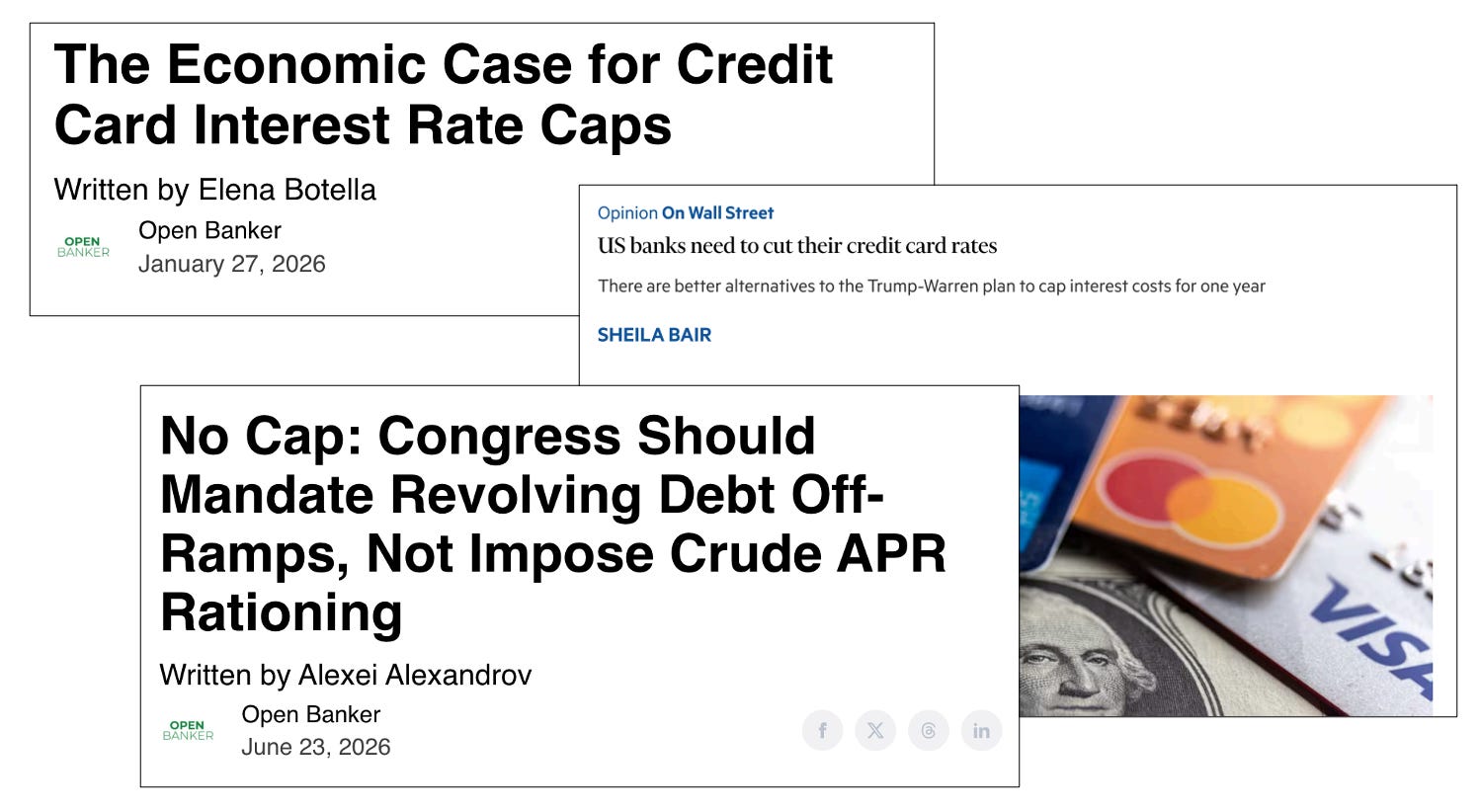
Others, including former FDIC chair Shelia Bair and my colleague Elena Botella, have made the economic case for a credit card rate cap on similar terms — there is a mid-point between the current market and the 10% rate cap backed by President Trump where price controls can both preserve access to the existing credit card market and deliver real relief for families. A win-win. But we should be asking a different question.
What if We Don’t Want a “Win-Win”?
What if, instead, we want a policy designed to discipline market participants that have grown out of control, extracting hundreds of billions of dollars in interest charges every year from a customer base held captive due to Americans’ rising financial desperation and continued corporate concentration? What if we thought this was especially important for companies that claim to serve the subprime segment when in fact they have used at-risk Americans to serve their quarterly earnings?
Put plainly, what if high credit card interest rates are not just a market failure but are instead the result of deliberate profiteering by bank executives?
Let’s take a step back and level-set. We should think about banking the way we think about any other utility or government-sanctioned monopoly. Banks get a franchise from the government (a bank charter) which comes with economic benefits unavailable to other market participants — cheaper access to capital and government bailouts from time to time when that cheap capital isn’t enough to save them from their improvident lending decisions. In exchange, banks that lend to families agree to price these loans to reflect their customers’ ability to repay, also known as risk-based underwriting. In theory, the public should also benefit from the fact that pricing loans solely based on risk forecloses banks’ ability to set interest rates at the profit-maximizing point.
Banks get a charter and we get cheaper credit.
Broken Social Contract
When banks break their deal with the public and pursue a business strategy of setting rates to reflect customers’ capacity to pay, we call that “predatory lending.” And the credit card industry has a predatory lending problem. As Botella explained succinctly, citing a barn-burner of a CFPB paper:
“Credit card interest rates have almost doubled in the past ten years, from an average of 12% to 21%. Some of that change was driven by interest rate levels set by the Federal Reserve. But the CFPB has estimated that roughly half of the rise in credit card interest rates was driven by rising lending margins from banks — e.g. the difference between the APR banks charge and the prime rate. The same report found that credit card default rates stayed steady throughout the decade, and that interest rate margins are rising across all credit tiers. Rising interest rates are not the result of default or other risk management: they are the result of lenders seeking higher profits.”
It appears that the credit card banks broke their end of the bargain, squeezing their customers and taking advantage of an affordability crisis that has pushed families into debt to pay for groceries, healthcare, and rent. The policy solution for predatory lending should not be a search for a “win-win” for the loan sharks and their victims.
There are better ways to deal with sharks.
Disciplining Markets
If I caught my kindergartener stealing all of the cookies from the cookie jar, I wouldn’t just give him some cookies and call that a solution. Modeling moderation might feel like a win-win — the kid would be following the rules at that moment and I would avoid a fight — but I’d be encouraging more cookie-stealing the next time my back was turned. Any parent in this situation would, at minimum, take away all the cookies. I’d probably take away his iPad too — that way he wouldn’t steal anymore, whether that’s cookies, candy, or his brother’s toys. The intervention is not merely a correction, it’s a deterrent.
In this case, the credit card banks are no different from my sneaky kindergartener — they respond to the incentives that the government sets and maximize their own returns at our collective expense. Here, the policy solution needs to end banks’ usury and to make sure the banks learn their lesson. The policy solution should be at least a little bit punitive, as long as we’re comfortable that it won’t destabilize the market or crash the economy.
Fortunately, we don’t have to worry too much about the spillover effects of a rate cap. As Brian Shearer at Vanderbilt Policy Accelerator explained last year in a widely cited paper, “banks can afford a usury cap and don’t necessarily have to deny cards or ratchet back rewards to do so, and Americans would see billions of dollars back in their wallets in the process.” (Of course, the banks themselves disagree with his analysis and Shearer disagrees with the banks’ disagreement.)
So where does that leave us?
The facts on the ground are clear. Congress and federal regulators have taken a hands-off approach to policing usury by banks. State lawmakers mostly have their hands tied by captured courts. In this vacuum, credit card companies are exploiting families’ financial desperation and pricing credit cards above what risk-based underwriting requires. They have been doing this for a long time and this dynamic appears to be getting worse.
Lawmakers should respond by, at minimum, enacting a cap on credit card rates that cuts deep into banks’ profits and delivers the kind of debt relief that voters are demanding — both because those with debt deserve recompense for banks’ rate gouging but also because voters are in a punitive mood and that’s how democracy should work. Lawmakers would be wise to ditch the bankers’ talking points and turn their voters’ anger into a policy with teeth.
Far from Alexei’s “crude APR rationing,” a 10% rate cap is both good policy and smart politics. The banks got caught stealing voters’ cookies. Lawmakers’ response should make sure it never happens again.
###
Mike Pierce is the Executive Director and co-founder of Protect Borrowers. This blog was also published on In Debt, a Protect Borrowers Substack and at Open Banker, an online publication about financial policy.]