By Mike Pierce and Alex Jacquez | October 30, 2025
In the wake of the stunning federal indictment handed down last weekend, it is clear that the growth of unfettered, app-based online sports betting is not just shaping the way sports fans interact with the games we love, but also the way the players themselves behave. As the U.S. Attorney prosecuting the current and former pro basketball players ensnared in “Operation Nothing But Bet” explained:
“As alleged, the defendants turned professional basketball into a criminal betting operation, using private locker room and medical information to enrich themselves and cheat legitimate sportsbooks…”
The phrase “legitimate sportsbooks” appears nowhere in the indictment. The feds do make a half-hearted effort to conceal the names of the online betting platforms central to this scheme.
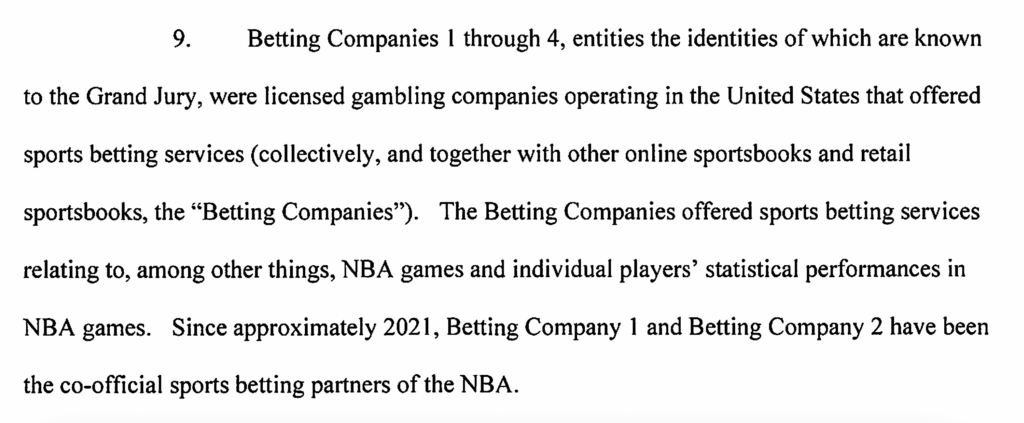
We know that the “co-official sports betting partners” of the NBA are online sports betting giants FanDuel and DraftKings—the tech companies driving the boom in online sports betting and the proliferation of so-called propositions or “prop bets.” Prop bets can include the performance of individual players—offering bettors the chance to make bets not just on the outcome of a game, but betting repeatedly throughout a single game on dozens of player stats, team stats, overall score predictions, and more. Easy access to online prop betting underpins the illegal gambling scheme at the center of “Operation Nothing But Bet.”
As the indictment alleges, Charlotte Hornets player Terry Rozier worked with six different co-conspirators to place a wide range of prop bets on the number of minutes Rozier would play in an individual game. Rozier then left the game early, causing those bets to pay out. Easy access to this kind of prop betting created an opportunity too good for Rozier and his co-conspirators to pass up—a single pro basketball player could alter his behavior and trigger a payday for all involved.
Young Men, Prop Bets, and the Rise of High-Frequency Sports Betting
In a 2018 decision, Murphy v. National Collegiate Athletic Association, the Supreme Court struck down a nationwide ban on sports betting and allowed states to authorize sports betting laws. Since then, FanDuel and DraftKings have conquered the sportsbooks, commanding more than 80% market share and driving annual sports betting from $5 billion in 2017 to $150 billion last year. Easy access to online sports prop betting may also be the driver of a shocking shift in the way an important segment of Americans engages with sports—a surge in betting and gambling debt owed by younger American men.
Polling by Protect Borrowers and Groundwork Collaborative shows that younger American men owe gambling debt at alarming rates and a substantial share are prolific online sports bettors—the latest sign that policymakers and economists are ignoring a rapid shift in the way Americans bet on sports and the financial consequences of sports gambling.
The poll we released last month, conducted by Data or Progress, found that among all likely voters online sports betting is widespread—and that the use of online sports betting platforms is much more common than other surveys have found. Among the 1,202 likely voters in our survey, fully 1-in-4 (26%) bet on sports online “a few times a year” or more, and nearly 1-in-10 (9%) do so weekly or daily.
Today, we released updated crosstabs from our September poll on debt, looking at behavior among voters by both age and gender—allowing us to examine more closely men and women under 45. We see that among male voters under 45, the story of gambling and gambling debt is markedly different, when compared to the rest of the country.
- The majority of younger men bet on sports online. Our survey reached 205 male likely voters under 45 years old. When asked about their participation in online sports gambling, more than half of these younger male likely voters (53%) said they do so at least “a few times a year.”
- Online sports betting by younger men is a regular feature of their lives. We dug deeper into the frequency of online sports betting by younger men and found that most younger men who bet on sports online do so at least “monthly.” Among those younger male likely voters who bet on sports online this behavior is typical—nearly 6-in-10 report betting on sports online at least monthly. This is nearly 1-in-3 (31%) of all younger male likely voters.
- High frequency sports betting is widespread among younger men. Nearly 1-in-8 younger male likely voters (12%) reported participating in online sports betting daily, with another 1-in-9 (11%) reporting participation weekly. In total, we find that nearly 1-in-4 younger male likely voters (23%) bet on sports online with high frequency (daily or weekly). Among those younger male likely voters who bet on sports online, this behavior is very common—nearly 4-in-10 report betting on sports “daily” or “weekly.”
As always in this space, this is a post about debt. Although our survey does not attempt to directly link online sports betting to sports gambling debt overall, we did ask about “sports betting debt” specifically, disaggregated from other types of household debt. We see sports betting debt break down similarly along demographic lines.
- Sports betting debt is more than twice as common among younger men, when compared to likely voters overall. As noted above, 90% of all likely voters report never owing a sports betting debt. Among younger male likely voters, this drops to 76%. Put differently, nearly 1-in-4 (24%) of younger male likely voters owe or have owed a sports betting debt, with more than 1-in-6 of all younger male likely voters (18%) reporting that they owe a sports betting debt right now.
- A substantial share of younger men report owing very large sports betting debts. Nearly 1-in-12 younger male likely voters (8%) report owing more than $5,000 in sports betting debt, with these debts heavily concentrated in the $5,001-$15,000 range. Younger male likely voters owe extraordinarily large sports betting debts (more than $15,000) at rates roughly in line with the population of likely voters overall. In contrast, younger male likely voters report debts between $5,001 and $15,000 at five times the rate reported by likely voters overall (5% of younger men vs. 1% of all likely voters).
While the online sports betting platforms bombard users with advertisements and promotional offers and become more closely intertwined with professional sports leagues, there is growing consensus that unfettered access to a wide array of exotic gambling opportunities is a negative for our culture. A Pew Research Center survey from earlier this month showed growing shares of Americans across demographics viewing sports gambling as a bad thing for both society and professional sports. Perhaps most interestingly, those who are most likely to use the product share this view. A full 47% of men under 30 view legal sports betting as bad for society, up from 22% just three years ago.
Looking back at our polling and the shocking allegations in last weekend’s indictment, we see a clear through line: online sports betting– particularly easy, on-demand access to prop bets—creates a set of incentives for both players and sports fans that is ruining pro sports. There is a clear need to strike a balance between the pre-Murphy widespread ban on sports betting and the post-Murphy wild west that we find ourselves in today, where tech giants use cutting edge attention-holding strategies to trap users, particularly young men, in a cycle of debt. Policymakers can take steps to strike that balance before it is too late– banning prop betting immediately can restore public trust in pro athletes’ performance, leagues’ command of their players, and the way sports fans interact with the games we love.
###
Mike Pierce is Executive Director of Protect Borrowers.
Alex Jacquez is Chief of Policy and Advocacy at Groundwork Collaborative.
This blog post, authored by Protect Borrowers’ Executive Director Mike Pierce and Groundwork Collaborative’s Chief of Policy and Advocacy Alex Jacquez, was also published on In Debt, a Protect Borrowers Substack.