By Sophie Laing | August 21, 2026
The student loan landscape is changing: with the One Big Beautiful Bill Act (OBBBA), there are new federal lending limits that will significantly impact current and future student loan borrowers. At the same time, state disinvestment in higher education continues.
Against this backdrop, students are forced to look for ways to fill in the funding gaps left in their wake. And private student lenders are already ramping up lending to take advantage. These gaps also leave room for another often-ignored and likely risky student loan: the state-backed private student loan.
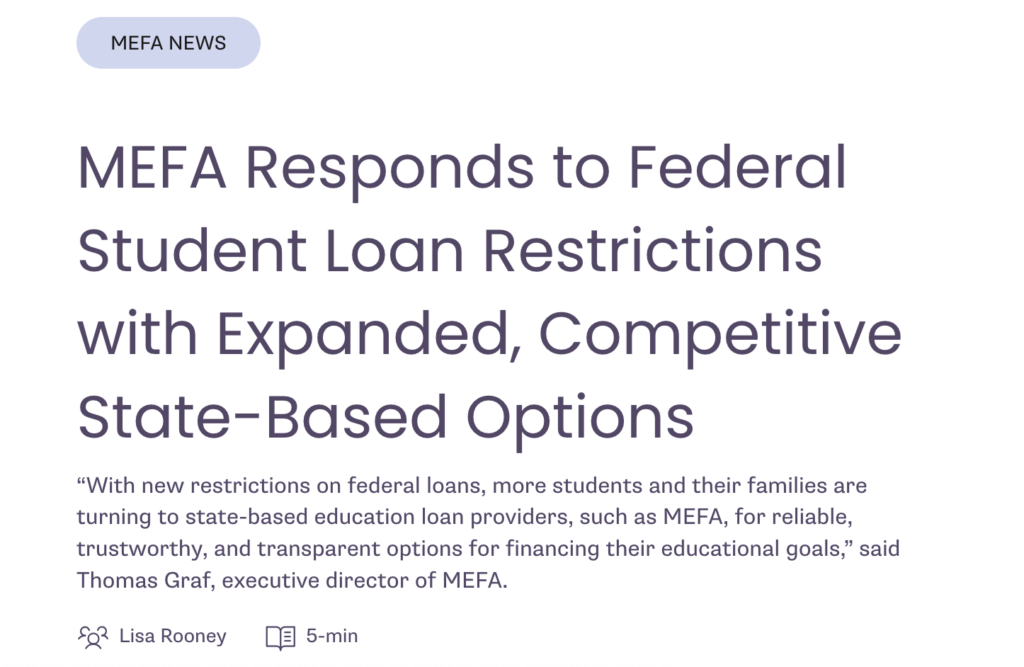
From MEFA’s website.
Lobbyists representing the state-based private lending industry have been making the rounds on Capitol Hill, touting these products as safer and more borrower-friendly alternatives that can help students in the wake of the financial aid cuts made in the OBBBA. Policymakers and higher education advocates should take caution when exploring state-backed private student loans as a solution to the student debt and college affordability crisis.
Little has been written about these state student loans, which exist in over half of states. I recently published an investigation and paper with Protect Borrowers, diving into the details of these loans. It is the first comprehensive study of state student loans and state lenders. The Worst of Both Worlds: An Investigation of State Student Loan Lending analyzes the marketing claims made by state student lenders, identifies common terms in state student loans, and discusses the impact of these loans on borrowers.
What are state student loans?
State student loans are loans made by a number of different entities. Some states house their loan programs in divisions of the state government, like Minnesota, Georgia, and Michigan. Other states, such as Maine, Vermont, Massachusetts, and New Jersey, have quasi-state agencies (nonprofit corporations that were enacted via legislation) that issue student loans. Many of these lenders started out as part of the Federal Family Education Loan Program business—a now-defunct federal student loan program in which private lenders originated the loans, which were backed by a federal government guarantee—and some still service federal loans in addition to their own private loan portfolios. Some agencies have been issuing their own private student loans for decades, whereas others’ loan programs are only a few years old. Although there is no central database of these lenders, it appears that there are about 30 states with active lending programs, loaning over $1.26 billion in AY 2023-24.
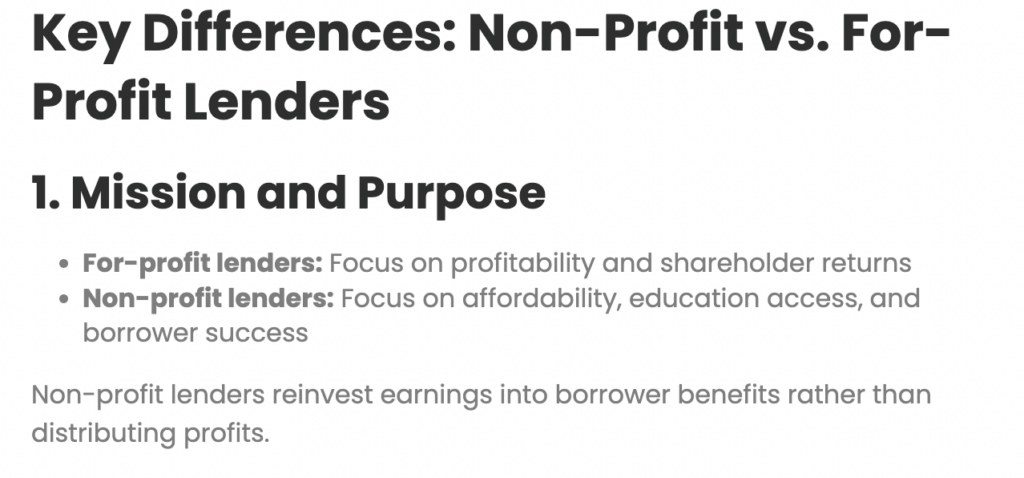
From RISLA’s blog.
These agencies typically lean on their nonprofit status and state affiliation to tout their loans as borrower-friendly options and better alternatives to traditional student loans.
Many of the lenders offer a combination of undergraduate, graduate, and parent loans. Some lenders offer forgivable loans, which are often marketed as “grants” with service requirements, such as working in a certain profession or location. These “grants” then convert to loans if a borrower does not fulfill those service requirements after graduation. Some lenders offer profession- or school-specific loans, limiting lending to students pursuing fields like nursing or teaching, or attending certain in-state public colleges. A number of state agencies also provide student loan refinancing.
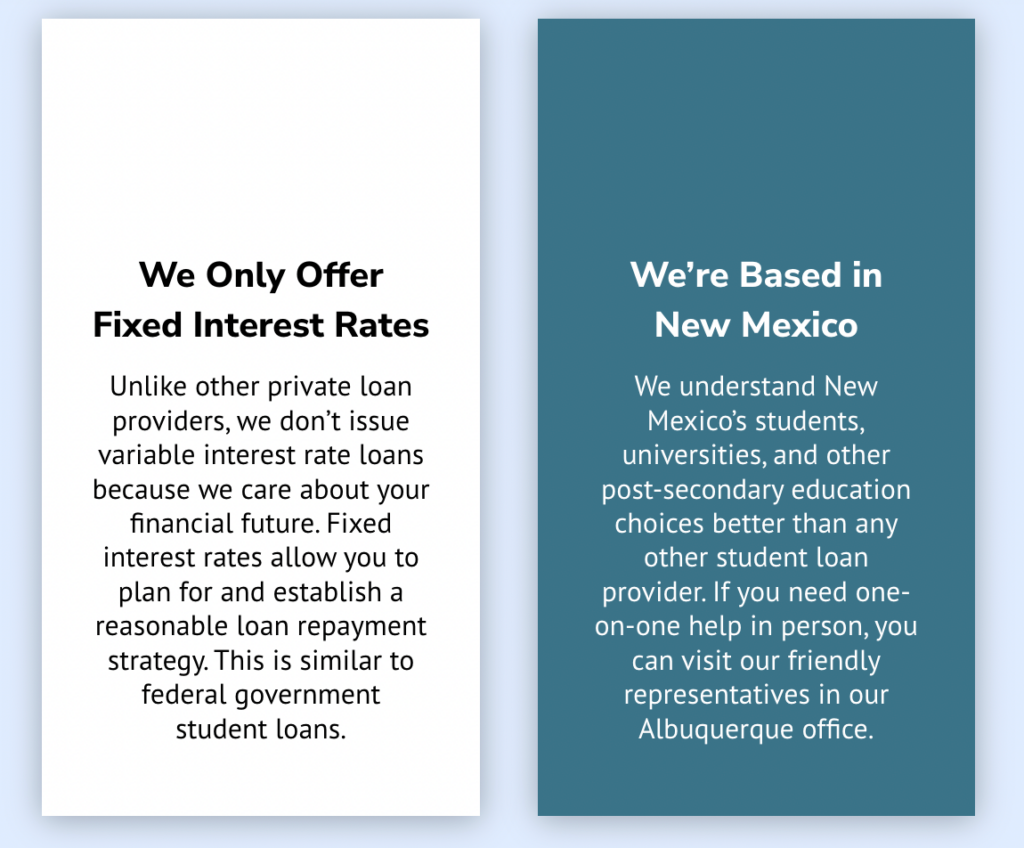
From New Mexico Educational Assistance Foundation’s “Top 10 Reasons to Apply for New Student Loans from NMEAF”
State agencies advertise their loans as uniquely beneficial to borrowers. They describe their loan products as a “low-cost way to pay for college,” and a “better private loan option.” They often lean on their nonprofit status, telling students and their families that state lenders are different from other lenders: they do not issue “bad loans” and in fact reinvest money “into helping students and families plan, prepare and pay for college.” While other private lenders are profit-driven, state student loan lenders tell borrowers that state lenders “prioritiz[e] affordability and borrower success over profit,” and use their localized “expertise and support” in the best interest of borrowers. State agencies repeat that they are “committed to helping students,” both “now and later.”
State student loans combine some of the worst parts of private loans with the worst parts of federal loans.
Traditional private loans have higher interest rates and fewer borrower protections than federal loans, but lenders have to sue borrowers to take them to court like any other creditor. Federal loans have better repayment and relief options (like Income-Driven Repayment plans, Borrower Defense to Repayment, Disability Discharges, Cancer Treatment Forbearances), but when borrowers default, the federal government can offset tax refunds and benefits and garnish wages with limited due process. State student loans often do both: provide borrowers with limited repayment and relief options, all while wielding the collection power of a state entity.
Despite state agencies’ claims, state student loans can be rigid, expensive, and come with draconian collection practices.
State agencies constantly tout their local nature and government or nonprofit status. They continually argue that they are better lenders than for-profit companies because the money made from their student loans goes back to helping students. The implication is that their loans are more borrower-friendly and that, when a borrower falls on hard times, their lender will have programs to help them. But this rosy picture is far from the borrower experience.
Instead, borrowers report no willingness from their state lenders to work with them when they hit hard times, documenting for the Consumer Financial Protection Bureau (CFPB) feeling betrayed by the lack of understanding and options. State lenders advertise “multiple repayment options,” but in reality there are very few options when it comes to repayment term length and plans, including whether or not interest or full payments are made while the borrower is still in school. There are only two agencies nationwide that publicly advertise repayment plans that allow borrowers to make monthly payments based on their incomes, but even these options fall short relative to the federal Income-Driven Repayment plans as their payment calculation formulas take into account a co-signer’s income.
Few state student loans offer truly low interest loans (0 or 1%) to borrowers. Others may advertise low rates, but often these are only available for borrowers with exceptional credit, and the rates for other borrowers can rise into the double digits. For example, Arkansas Student Loan Authority advertises 2.74% to 7.71% APR for its undergraduate student loans. In small print, it notes that the 2.74% APR rate takes into account an auto-debit reduction of .25%. Furthermore, when diving deeper into the loan details, the lowest APR—2.99%—is only available for borrowers with FICO scores of 810 or more who enroll in immediate repayment (as opposed to interest-only or deferred payment). The average credit score for an Arkansan is 693—which puts the lowest APR for an ASLA student loan at 7.48%.
Unsurprisingly, borrowers with state-based loans face similar challenges as those with federal or traditional private student loans.
Borrowers have made thousands of complaints to the CFPB about their state-based student loans. Many borrowers report feeling duped by their state student loan lender: they thought (as the state agency has advertised) that this was a lender they could trust. Instead, when they fell on hard times, they found a lender no different than any other private company. For example, a Rhode Island Student Loan Authority (RISLA) borrower reported receiving “a lot of mailers from RISLA saying that they were the loan company that would really help me.” As a first-generation college student, the borrower and her family “were eager” to find smart ways to finance her college education. But after taking out a RISLA loan and later experiencing difficulty with cosigner release and inflexible repayment options, she regretted her choice. She explained: “Boy were we wrong. RISLA has done nothing to help me, and they do not look out for their customers, only themselves.”
Borrowers turned to their state lenders after experiencing job loss. Instead of finding the flexibility and understanding they were promised, they were left out in the cold. When inquiring about new payment options in unemployment, one borrower was “flat-out told no, that there [was] no help.” This response made the borrower feel like Massachusetts Educational Finance Authority (MEFA) did not care “whether [she] starve[d] or [couldn’t] make rent.” A South Carolina Student Loan borrower got a temporary forbearance after job loss, and when it ended, he contacted the agency to see if he could get any assistance resuming the regular repayment amount. But he was similarly told that there “were no options,” and the agency would not accept his request for a hardship forbearance. As a result, his loan was transferred to a collection agency which then threatened to garnish his wages and seize his family’s tax refunds.
Borrowers report confusion over what type of loan they were taking out through these agencies, whether private, federal, or something in between. One Vermont Student Assistance Corporation (VSAC) borrower, a single mother who was helping her son apply to college, turned to VSAC for help with her son’s FAFSA application. She did not realize until repayment started that the loan her son had applied for was a VSAC private loan: she complained to the CFPB that “as a single parent getting their child ready for college” she had “relied on [VSAC].” She felt that [VSAC] neglected [their] role,” and that she had lost “all confidence” in VSAC and its stated mission.
Many complaints about these state agencies mirror complaints about any other federal or private lender or servicer. Borrowers report problems with customer service, payment issues, credit reporting, and harassing debt collection. One borrower described MEFA’s loan servicing as “nothing but terrible communication, hassles, and a total disregard for [her] situation,” and “the worst customer service” she could “ever imagine.” Another MEFA borrower complained to the CFPB about the difficulties he was running into making payments on multiple loans. Despite having auto-debit set up, once the loans were transferred to a new servicer, he was “constantly told [the] loans [were] delinquent, in default and [were] being sent to a collection agency, even though they [were] automatically paying on time and over the amount required.”
These complaints are troubling on their own, for any part of the student loan system. But they are especially concerning when these state lenders are promising students a different experience.
When borrowers are mistreated by state student loan lenders, they may have fewer rights than borrowers abused by private student loan companies.
Although state student loan lenders may offer similar products and borrower repayment experiences as private student loan lenders, they don’t play by the same rules. Instead, many state agencies attempt to assert special protections due to their state affiliation that make it hard for borrowers to hold them accountable for harm. For example, say a borrower experiences repeated, inaccurate credit reporting and incorrect auto-debits. The state agency refuses to remedy the problems, and the borrower sues. Or, maybe a borrower falls behind on his loan as a result of these errors but doesn’t hear from the agency for 10 years, when they decide to sue him in a collection action. In both instances, the borrower may run into some big legal roadblocks that they wouldn’t with any other private lender: sovereign immunity, the doctrine of nullum tempus, and special carve-outs in state consumer protection law.
Sovereign immunity protects state actors from being sued. State student loan agencies vary in form and structure, and courts have come to different conclusions as to whether or not they are entitled to assert sovereign immunity. When they are protected by sovereign immunity, it makes it much more difficult for borrowers to hold these agencies accountable for illegal actions. A recent Supreme Court case, Galette v. N.J. Transit Corp., indicates that the most important factor in the analysis of whether or not an entity is an arm of the state, and can therefore benefit from sovereign immunity, is whether the state would have to satisfy a judgment incurred by the entity. Even across state agencies that appear similar in formation, i.e., were created in the 1980s by legislatures to participate in the Federal Family Education Loan (FFEL) business, there is significant variety in a state’s involvement in the agency, agency litigation, and whether or not states are on the hook for agency judgments.
The doctrine of nullum tempus occurrit regi literally translates to “no time runs against the king.” It stands for the principle that statutes of limitations do not apply to the state. Although the doctrine has been limited in many states, it is still alive and well in others. In private student loan collection cases, borrowers can sometimes assert a statute of limitations defense if the private lender tries to collect on the student loan past the state’s statute of limitations. But as they do with sovereign immunity, state agencies may try to assert that statutes of limitations do not apply to them in states where nullum tempus is the law.
Sovereign immunity and nullum tempus aren’t the only ways that state lenders seek special treatment: some state agencies are specifically carved out from the state’s consumer protection regulation. For example, the Finance Authority of Maine (FAME) is exempt from certain requirements under Maine’s Student Loan Bill of Rights, Private Education Lending Registry, and the Private Education Lending Law. Similarly, VSAC is exempt from Vermont’s Fair Credit Reporting Act.
Policymakers should learn from the past before investing in state student loans for the future.
Student loan borrowers are struggling. Loan defaults are up, and new federal lending caps mean that borrowers will have to turn to alternative loan products to fill in funding gaps. State student loan lenders are already advertising their loans as safer and better than traditional private loans, and ramping up their lending to meet the moment.
Perhaps even more concerning, some federal lawmakers want to make it easier for schools to steer students into state-based student loans by carving them out of existing federal laws meant to ensure transparency and prevent corruption and kickback between schools and lenders. Without improvements to the state loan programs themselves, this could do more harm than good for families.
If state student loan lenders want to advertise their loans as meaningfully better than private loans, they need to make significant changes, including: lowering interest rates for all borrowers; providing affordable, long-term income-sensitive repayment plan options and disability and health-related discharge and forbearance programs; and forgoing aggressive state collection powers when borrowers fall behind.
- States should offer truly low-interest loans. The benefits of lower interest rates are more affordable monthly payments, and also a payment structure that, if the borrower has access to Income-Based Repayment, is hopefully not negatively amortizing. Offering truly lower interest rates, between 0-2%, would mean that state student loans would be meaningfully different from traditional private student loans (as well as current federal loans).
- State student loan lenders must offer meaningful income-sensitive repayment plans to borrowers. Long-term, affordable income-driven repayment plans, mirroring (or improving upon) federal Income-Driven Repayment plans should be provided by state student loan lenders. These plans also need eventual relief, or borrowers will be indefinitely saddled with debt.
- State student loans should offer relief programs to borrowers struggling the most. If state student lenders have their state residents’ wellbeing and success in mind, they would provide programs like Disability Discharge, borrower-friendly co-signer releases, Closed School and School Misconduct Discharge protections, and other forbearances, discharges, and deferments for when borrowers hit hard times. Without these protections, state-backed private loans will never be preferable to federal loans or traditional private loans.
- States should not use the most aggressive collection tactics of the state to deny borrowers opportunity to raise defenses, negotiate affordable repayment plans, or rehabilitate their loans. Employing state collection tools, like offsets and garnishments that bypass the judicial system, leaves borrowers in financial distress with little ability to negotiate or rehabilitate their financial situations.
Conclusion
State agencies are marketing their loans to students as safer options than traditional private loans. But digging into these loan products tells a different story. In actuality, borrower-friendly private loan alternatives would include lower interest rates, better income-sensitive repayment options, forbearance, deferment, and forgiveness related to disability and other temporary and permanent hardship, and fair collection tactics. Without these, borrowers will turn to student loan programs thinking they are in good hands, when instead, they will find harsh repayment terms and even harsher collections when they fall on hard times. In light of recent federal student loan changes, policymakers must increase transparency and protections for borrowers in the private loan market.State agencies engaged in student lending must take this opportunity to review and reform their programs, or risk further burdening the very borrowers they aspire to help.
###
Sophie Laing is a legal aid attorney working on issues of consumer debt and a fellow at Protect Borrowers. She has served as a legal aid negotiator for the Department of Education’s Negotiated Rulemaking, and led a student loan clinic at UC Irvine School of Law. This blog was also published on In Debt, a Protect Borrowers Substack.