By Bonnie Latreille, Persis Yu, and Eileen Connor | October 14, 2026
This blog is Part 3 of a three-part series that examines the shadow network of vendors that control the federal student loan market and the role they play in driving student loan defaults. See Part 1 here and Part 2 here.
Introduction
Over this past year, this three-part series examined the shadow network of vendors that control the federal student loan market and the role they play in driving the student loan default crisis. Part 1 of this series laid out the scale of the student loan default cliff. Part 2 traced how a decade of procurement failures—including a broken servicing platform, a cancelled private collection agency (PCA) contract, a collapsed recompete, and a March 2026 handoff to the Treasury Department—left the government without a coherent apparatus to collect on federal student loan debt. Nearly a year after the Trump Administration announced it would resume “involuntary collection,” the federal student loan collections apparatus still does not exist in any stable form. In the most recent announcement on default, the Trump Administration revealed that it was finally letting borrowers apply for default relief programs… using the internet. The third and final blog in this series looks at the root of the collection problem: mounting evidence suggests the U.S. Department of Education (ED) may not even have the data it needs to certify these debts for collection in the first place—a legal prerequisite the government cannot skip no matter which vendor is holding the file.
Disproportionate Burdens, Disproportionate Consequences
Federal student loans are not like other kinds of debt. A borrower who falls behind on a credit card or a private loan can only be forced to pay if their creditor successfully sues and secures a court judgment. However, a borrower who defaults on a federal student loan receives none of those due process protections. Through administrative wage garnishment, ED’s contractors can order an employer to withhold up to 15 percent of a borrower’s income without a judge or a court order. Through the Treasury Offset Program, the government can seize a borrower’s tax refund, including the Earned Income Tax Credit, and reduce Social Security retirement and disability checks below the poverty line. And federal student loans carry no statute of limitations, so a debt taken on at age 22 can still be collected at age 72 (and often is!).
Historically, ED has not exercised these tools evenly; instead, certain populations of borrowers disproportionately bear the fallout of falling behind on student debt. While race data on student loan defaults is limited, our analysis shows that at each stage of collections, Black borrowers are more likely to face the worst outcomes.
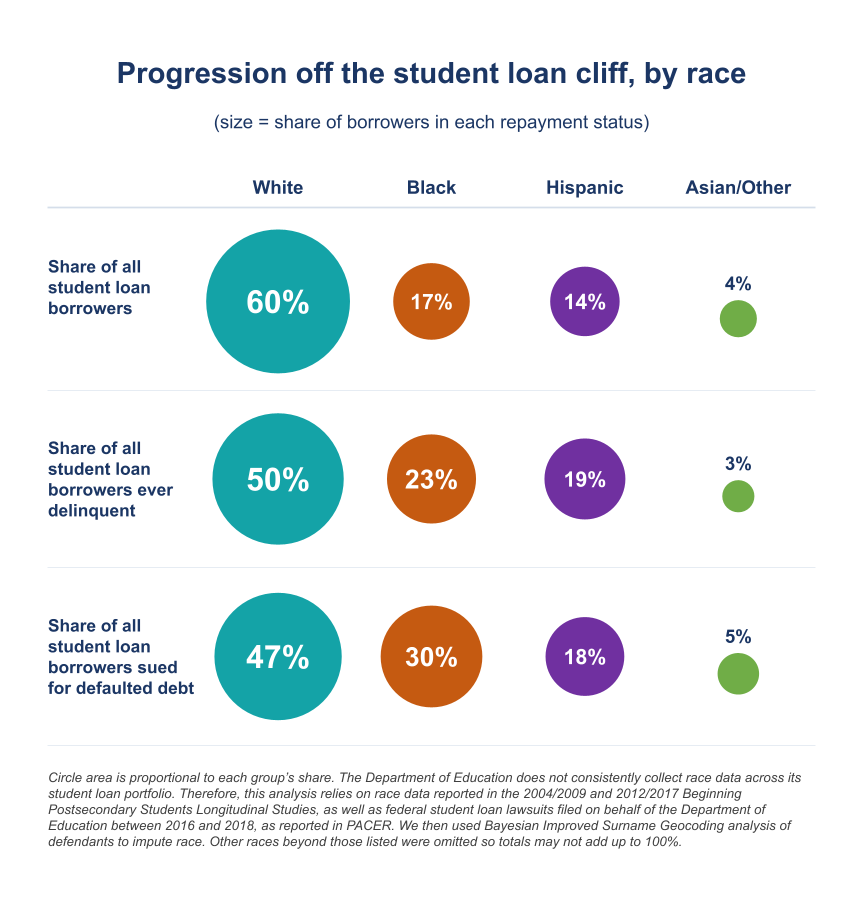
These findings are consistent across other research. A 2024 survey by Pew found that half of Black borrowers and 40 percent of Hispanic borrowers report having defaulted on a student loan, compared with less than a third of white borrowers. Among borrowers who have ever defaulted, roughly three-quarters of Black and Hispanic borrowers have redefaulted, compared with a much smaller share of white borrowers.
More recent analysis of the 2025 default cliff found that a new borrower entered default roughly every nine seconds, and those borrowers were disproportionately borrowers of color. In fact, the delinquency rate of Black borrowers was double the overall national rate. As a result, when the government’s collection tools misfire, they misfire onto the population least able to absorb the hit.
If at First You Don’t Succeed, Fail Three More Times
For the past decade, ED has repeatedly failed to figure out a functional, equitable way to administer federal student loan collections, despite repeated commitments across administrations.
- The old regime of using private collection agencies was scrapped. In November 2021, ED terminated its contracts with the private collection agencies (PCAs) that had handled defaulted accounts for decades, citing the perverse commission incentives documented in cases like the CFPB’s enforcement action against Performant Recovery. Accounts were recalled to the Default Management Collections System (DMCS) pending a transition to new Business Process Operations (BPO) vendors. Unlike the PCAs, BPOs were hired to perform specific collection tasks instead of managing entire defaulted accounts, and were to receive payment based upon task completion instead of commission.
- The BPO vision was plagued with problems. As the Congressional Research Service confirms, ED “planned to, but did not” transition defaulted-debt servicing to the newly contracted BPO vendors (EdFinancial, F.H. Cann, Maximus, and MOHELA). Those vendors ended up handling borrower-facing servicing questions, not collections. As an interim solution, ED extended its contract with Maximus to continue default servicing.
- The DMCS-Next recompete collapsed. As discussed in Part 2, in 2022, ED tried to award a rebuilt, accountability-focused collections contract requiring full compliance with third-party debt collection law. Only Maximus bid, and then, as ED itself conceded, walked away rather than accept legal exposure under the Fair Debt Collection Practices Act following an adverse ruling in Bodor v. Maximus. The recompete collapsed with no replacement contract in place.
- Treasury PCAs also pulled back. In March 2026, ED handed operational responsibility for roughly $180 billion in defaulted debt to Treasury’s Bureau of the Fiscal Service, which has existing contracts with five PCAs—CBE Group, Coast Professional, ConServe, Pioneer Credit Recovery, and Transworld Systems—to handle outbound collection. Within months, Treasury rescinded those task orders, citing a vaguely described “procurement error.” As of this writing, it is not publicly known which vendor, if any, is currently tasked with collection on Treasury-referred accounts.
It’s Strange That, After This Many Tries, Collections Is Still Off
Notably, each structurally different attempt to reform collections failed to produce a stable collections apparatus. Despite Education Secretary Linda McMahon’s repeated threats to turn on the student loan collections apparatus, as of today, collection efforts remain functionally “off.”
That is not a coincidence. Each attempt ran into the same underlying political and structural problems. The PCA model failed due to commission incentives. The BPO collections model failed to ever launch because ED set “Cadillac standard” benchmarks for collections but declined to pay for such service. The recompete failed because the one company that runs the platform of record could not square legal compliance with its own business model. And the Treasury handoff appears to be failing on some version of the same operational failures that plagued ED’s own systems. In other words, collecting federal student debt lawfully has never been profitable, and collecting it profitably has never proven lawful.
Amid all of this, ED itself announced on January 16, 2026, that it was delaying implementation of administrative wage garnishment and Treasury offsets. The official reason given was to allow borrowers time to enter into new repayment plans created by the One Big Beautiful Bill, though the announcement came days after the first garnishment notices had already gone out and after sustained public pressure from advocacy groups. As of this writing, involuntary collections remain paused, with no restart date announced.
Maximus is currently operating under emergency bridge awards with, as far as the public record shows, no indication of what ED’s long-term plan actually is. A system this consolidated should be easy to hold accountable. Instead, as Part 2 argued, it has become nearly impossible to discipline: pulling the one contract that runs the platform would mean detonating the system that tracks over 9 million borrowers’ debts.
The Bigger Problem: Can ED Even Certify These Debts?
Underneath the vendor churn sits a fundamental question: are these debts even collectable? Before a defaulted debt can be referred for Treasury offset, the Secretary has to certify that the debt is accurate and legally enforceable.
Certification Is Not Optional
Before an agency can refer a debt to Treasury for offset or cross-servicing, the head of the agency (or a delegate) must certify in writing that the debt is valid, legally enforceable, and that there are no legal bars to collection, and that the agency has complied with all prerequisites to collection under applicable law.
Certifying that a debt is accurate requires having accurate data on the debt in the first place. As Part 2 of this series documented, the default database is rife with incomplete or inaccurate records. Former federal officials described ongoing “material deficiencies” in DMCS, such as dummy Social Security numbers, inaccurate loan balances, missing communication records.
For years advocates have warned about systemic issues with borrowers’ loan records missing, in some cases, years worth of data. Abuses by Affiliated Computer Services (ACS), a notoriously shoddy company that once managed the largest portfolio of student loans combined with a mass exodus of some of the largest servicers and the ensuing loan transfers, has meant that significant portions of the loan portfolio face real documentation issues.
This begs the question: Can this debt be lawfully certified for collection at all?
Litigation against both the government and its contractors suggest it cannot. In Bodor v. Maximus, borrowers sued the default servicer for seizing tax refunds from borrowers who had contested the legal enforceability of their debts. The court noted that Federal Student Aid (FSA) had sent Maximus a formal “letter of concern” over the company’s failure to follow contractual instructions for applying borrower-defense tags in DMCS to halt collection on accounts that should have been paused. Maximus’s own corporate representatives testified they made a unilateral decision to stop processing those tag requests despite an explicit directive from FSA. If a system of record can misclassify which accounts should be excluded from collection, it is fair to ask whether it can reliably tell you which accounts should be included in the first place—and whoever signs a certification is putting their name behind data they may not actually be able to vouch for.
There is precedent for what happens when that data is wrong at scale. In Calvillo Manriquez v. DeVos, the court found ED in civil contempt in 2019 for continuing to collect against more than 16,000 former Corinthian College borrowers whose loans should have been flagged and paused following a court order.
Uncertifiable, Uncollectable, Unbothered
Put together, the record supports a straightforward conclusion: given documented, persistent gaps in DMCS’s underlying data, the Secretary is not in a position to certify that the debts sitting in that system are accurate, legally enforceable, and free of legal bars to collection. That is true whether the certifying official sits at ED or, following the March 2026 interagency agreement, at Treasury. A borrower whose loan balance is wrong, whose default date is wrong, or whose account was never properly flagged for a pause that should have applied to it, is not a borrower whose debt can lawfully be certified, no matter how many times the underlying contract changes hands. Borrowers have rights against wrongful collection.
ED has changed vendors, changed agencies, and changed collection tools four times over in the span of a few years, and at no point has it paused to audit whether the data underneath any of those systems is actually accurate. Any borrower accounts that are incomplete or show evidence of errors should be deemed uncollectable and immediately removed from collection and cancelled.
A collections system that shuffled between vendors cannot credibly certify the very debts it wants to collect. Any attempt to use administrative wage garnishment or Treasury offset without a proper audit will likely result in liability for whichever contractor takes over the debt collection contract. But more importantly, collecting on uncollectable debt will illegally siphon money from the most vulnerable borrowers who can afford it the least.
###
Bonnie Latreille is a visiting Senior Fellow with the Debt Collection Lab at Princeton University. She was the former Student Loan Ombudsman for the U.S. Department of Education and has spent more than a decade helping borrowers navigate the pitfalls of the student loan system.
Persis Yu is the Deputy Executive Director and Managing Counsel at Protect Borrowers. Persis is a nationally recognized expert on student loan law and has over a decade of hands-on experience representing borrowers.
Eileen Connor is the President and Director of Project on Predatory Student Lending. She has led PPSL’s landmark litigation efforts, representing more than two million borrowers and canceling more than $50 billion in fraudulent student loans.