Heads, Banks Win. Tails, You Lose
By Protect Borrowers | November 13, 2026
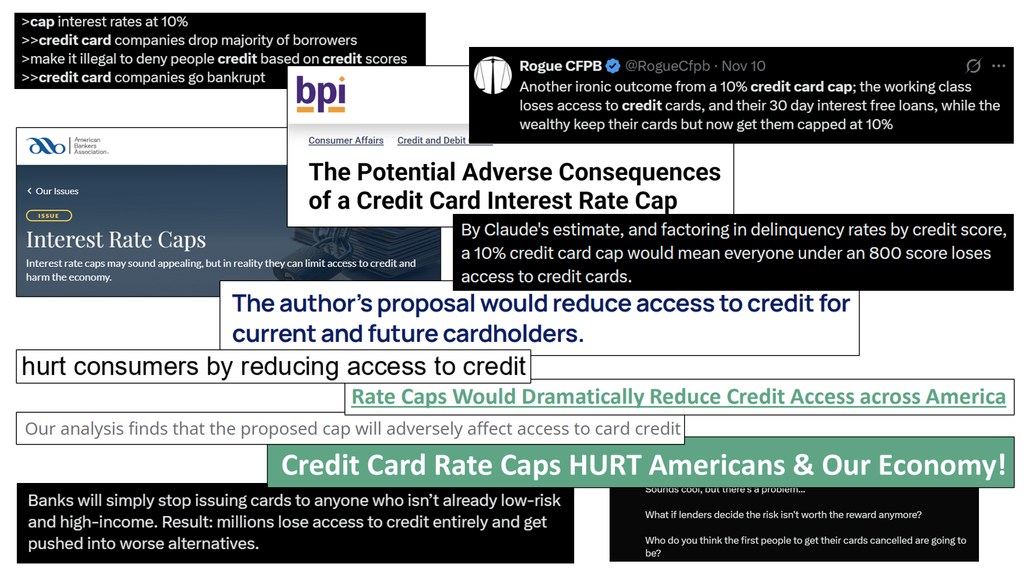
Credit card issuers and their lobbyists have one, singular argument that they deploy in response to any kind of regulatory proposal. If you do anything that would reduce their ability to extract runaway profits from borrowers, they will have to “cut access to credit.”
That argument is surfacing again and again in the current debate about capping credit card interest rates.
There are longstanding legislative proposals to cap rates in both chambers of Congress and this was one of then-candidate Trump’s most defining promises to help address rising costs on the campaign trail. Once elected, President Trump paid lip service yet again to the idea of capping rates at 10 percent. The incoming 120th Congress has an historic mandate to lower costs, tackle corporate corruption, and hold bad economic actors and the Trump Administration accountable for squeezing every last penny out of working families over the last several years. Wall Street is already worried about the investigations and hearings soon to come from the new Congress.
If the economic populists who soared to victory earlier this month have any influence on the congressional agenda, members from across the country and all political factions will soon have to stake out a position on capping credit card interest rates—a policy that is literally more popular among voters than Santa Claus. Industry will wage a long and ugly fight, and resurrect familiar boogeymen about “unintended consequences.”
The good news is we’ve actually had this fight before—and the financial services industry already showed us all of its cards—when the Consumer Financial Protection Bureau (CFPB) tried to cap credit card late fees under the previous administration.
There’s a lot we can learn from that story.
The Fight to Cap Late Fees
In 2024, the CFPB proposed a rule to cap credit card late fees at $8. It came to the $8 threshold after analyzing the growing margin between credit card issuers’ collection costs and the late fees they charged consumers to allegedly cover those costs. The CFPB found that since 2021, late fee income exceeded collection costs by more than fivefold. In other words, issuers were raising late fees for no reason other than to rake in more money.
Late fees have steadily crept up year over year, and are now about $37 per late payment (up from around $32 when the rule was first proposed). These late fees often pose a significant financial hurdle for struggling families, as they’re charged every month a payment is late, on top of interest. But late fees are an astoundingly small share of credit card issuers’ revenues—relative to the storm they kicked up against the rule.
In 2022 (the last year for which the CFPB provided comprehensive revenue data that includes interchange fees), credit card issuers collected $14.5 billion in late fees, which is a lot for working families but accounts for merely 7.7 percent of credit card issuers’ annual revenue. About 56 percent of revenue came from a whopping $105 billion in interest charges, and about 31 percent from interchange fees totaling $57 billion. You can trust that the picture has only gotten worse—in 2024, Americans paid over $160 billion in interest and $17 billion in late fees.
Given the chart above, does capping (not eliminating) a profit stream that accounts for 7.7 percent of annual revenues significantly threaten a credit card issuer’s bottom line? Does it cut into card issuers’ margins enough that they will have to stop lending to people, even though that would certainly reduce their revenues much more?
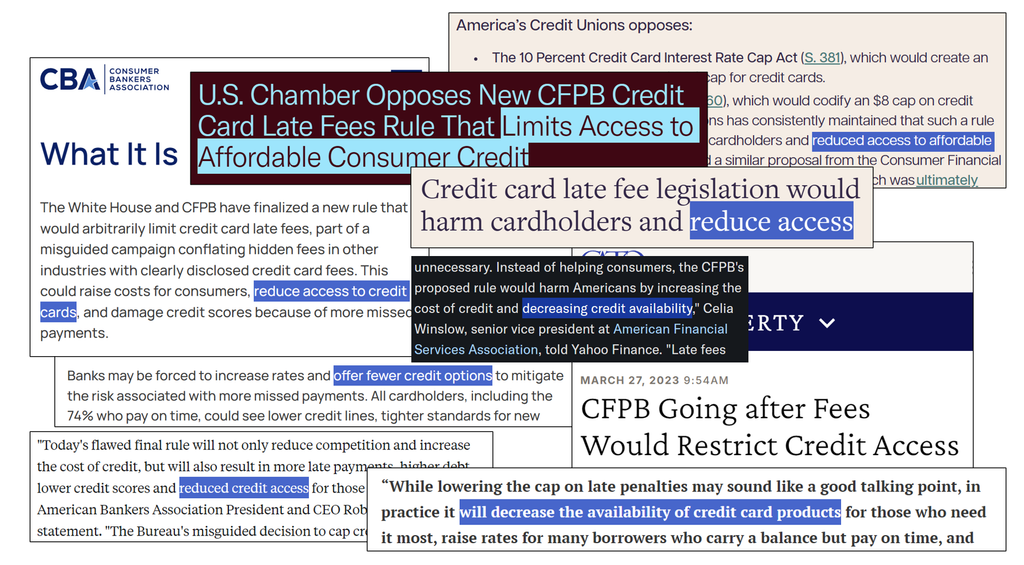
Probably not. But industry lobbyists would have you think otherwise. Like an army of ventriloquist dolls, the Consumer Bankers Association, U.S. Chamber of Commerce, America’s Credit Unions, Cato Institute, and other industry-aligned groups warned in unison that capping late fees would reduce credit access—without any serious economic analysis to support the claim.
What credit card banks actually did was even more insidious. Banks didn’t take any steps to reduce credit access. But upon hearing news of a proposed regulation that had not yet been implemented, many major issuers—including Citibank, Barclays, Synchrony, and BreadFinancial—raised their interest rates by about three to five percentage points in alleged preparation for the rule. Customers at Synchrony and BreadFinancial even received notice that they would be charged new monthly fees of $1.99 to $2.99 for paper statements. To protect less than 7.7 percent of annual revenue, the industry banded together to cause pain to borrowers and fearmonger to policymakers. And, to be clear, they raised rates and announced new junk fees before the late fee rule even went into effect.
Industry groups filed a lawsuit with a Texas judge under the jurisdiction of the notoriously pro-corporate Fifth Circuit Court of Appeals. A judge issued a preliminary injunction to halt implementation of the rule while the case continued to move through the courts. When President Trump returned to the White House, he appointed Russell Vought to wage an illegal campaign to dismantle the CFPB while throwing out favors to corporate donors like candy. In May 2025, the Trump-Vought CFPB switched sides and filed a motion to abandon the late fee rule and scrap it altogether.
Meanwhile, the CEOs of Synchrony and BreadFinancial happily noted to investors on the record that they would not lower their interest rates or roll back new fees, even though the boogeyman they blamed for raising costs had disappeared. Synchrony’s CEO Brian Doubles said:
“We feel pretty comfortable that the rule has been vacated. With that said, we don’t currently have plans to roll anything back in terms of the changes that we made.”
BreadFinancial’s CEO Ralph Andretta echoed:
“At this point, we’re not intending to roll back those changes, and we’ve talked to the partners about that.”
The fact that some banks could raise rates as a threat, without repercussions, only underscores how credit cards don’t operate by the usual laws of supply and demand. It also makes it impossible to take at face value credit card banks’ actions as “financially necessary,” rather than an effort to bully their way out of regulation.
The Lesson: Don’t Give in to a Bully (or His Boogeymen)
So what does this all mean for folks now thinking about the credit card interest rate fight? It means we’ve already tried small(er) potatoes, and industry showed us its hand.
TL;DR: A federal agency attempted to use its existing authority to impose a reasonable, research-backed cap on flat late fees, which account for far less than a tenth of the annual revenue of credit card issuers, and would frankly do far less to lower costs than a general interest rate cap. Industry put forth the exact same argument as they are now, and rallied together to fight the rule in court. Not satisfied with just throwing out the rule once the administration changed, their political allies violated dozens of federal laws to rip the CFPB apart and wage a personal vendetta against the federal employees who helped come up with the rule.
Meanwhile, credit card banks were quite glad to use the CFPB rule as a scapegoat to jack up costs even further, but then refused to lower costs when the rule vanished.
That’s the same playbook credit card companies used on interest rates: every time the Federal Reserve raises its rates, issuers do the same, but when the Fed later lowers its rates, issuers keep their rates elevated. That’s how credit card issuers have more than doubled their profit margins since the financial crisis. In the words of our friend Brian Shearer, it’s a “one-way ratchet.”
If you are a policymaker or staffer, the lesson here is clear. Credit card banks are bullies. You don’t stand up to bullies by acquiescing, trusting their numbers without testing them, or hoping they come to the table with an air of reasonableness and compromise. They want every last concession you could give them, and more. Their actions speak for themselves and show that credit card banks are greedy and entitled beyond belief, and they must be reined in.
Taking aim at credit card interest will be a bigger fight than capping late fees, and it will do much more to reduce credit card profits. But that’s a good thing, and it’s what Americans voted for earlier this month. By a jaw-dropping 8-to-1 margin, Americans of all political parties, spanning age, gender, race, and education, want government action to cap credit card interest rates. Opposing a cap would put someone to the right of President Trump’s proposed 10 percent rate cap.
Capping credit card interest rates is the fastest way for Congress to significantly lower costs for working families, without spending a single taxpayer dollar. Over 40 percent of U.S. adults and half of credit cardholders cannot afford to pay off their balances and carry more than $1 trillion in credit card debt from month to month. Out of every dollar of wages that workers gained since 2022, 52 cents have gone straight to debt payments. For every day that President Trump and Congress fail to enact a 10 percent rate cap, credit card banks are charging working families an additional $368 million in interest.
People are drowning in debt. Americans can’t afford another year, another month, even another day of sky-high interest rates bleeding their paychecks dry. It’s time to fight the bullies and cap credit card interest rates.
###
This blog by Protect Borrowers was also published on In Debt, a Protect Borrowers Substack.