In 2026, More Americans Are Paying Later and Buying Never
By Jennifer Zhang | August 6, 2026
Last week, the fintech Klarna broke into (or perhaps, kickstarted?) the consumer electronics leasing market, as the financing partner for Apple Upgrade—a new program that allows customers to rent an iPhone, iPad, or other Apple product for one to three years.
For this service at least, Klarna is shedding the “buy” part of its Buy Now, Pay Later (BNPL) identity. At the end of an Apple Upgrade lease term, customers won’t actually own their device. Instead, they can pay a “purchase fee” to keep it, enroll in a lease for a newer and even more expensive device, or return it after paying a majority or more of the original retail price. The Apple Upgrade program is the latest chapter of a devolving story: priced out of just about everything, Americans have been told first to cut back, then to borrow, and when even BNPL fails, to rent.
The traditional finance business model is simple. Lenders extend credit. Families repay debt with interest. For most of the modern history of the economy, consumer lending was a separate business—a market where families were banks’ customers and families used household debt and credit to buy things.
Apple and Klarna are doing something different. Apple is Klarna’s customer, not you. Apple owns your phone, not you. Apple might soon let lenders even flip a kill switch if you miss a payment, locking you out of your device. Apple is selling you to Klarna, not the other way around.
How It Works
Compared to buying a phone outright or even financing the purchase of a phone, renting a phone from Apple is a pretty bad deal.
Customers who want to lease an Apple device can opt for a 12-, 24-, or 36-month lease. They make monthly payments for the duration of the lease, which can range from $11.99 (for the iPad mini over 36 months) to $108.01 (for the Mac Studio with its most expensive chip, over 36 months). Only certain products are eligible for the Upgrade program, which appears to primarily include the latest generation of devices across the iPhone, iPad, watch, and Mac lines. Currently, iPhones and watches appear constrained to 12- or 24-month leases, while iPads and Macs are limited to 24- or 36-month leases.
At the end of a lease, customers have three options:
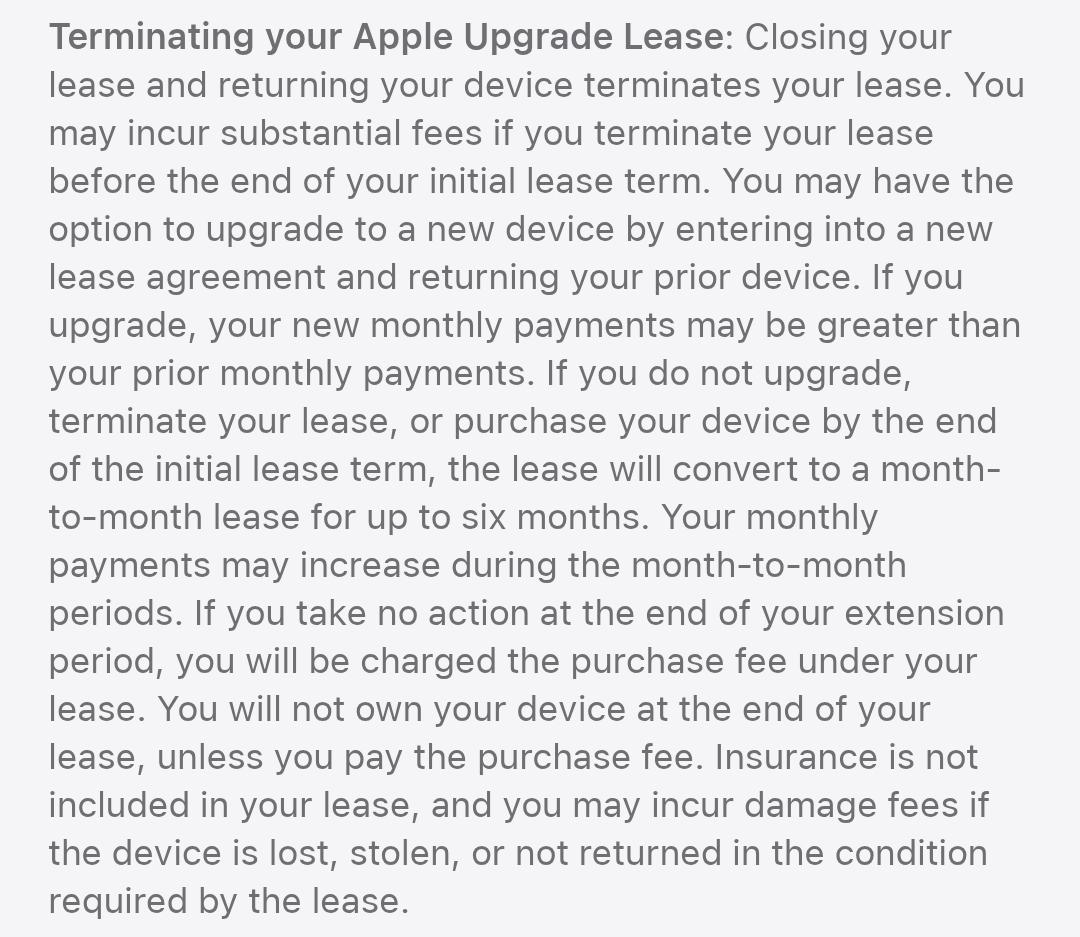
- You can upgrade to a newer device, but likely pay more each month. Apple notes that “if you upgrade, your new monthly payments may be greater than your prior monthly payments” (see screenshot below).
- You can pay an additional purchase fee to keep the device, which is equal to the difference between the original retail price and the sum of your monthly lease payments. For customers who are financially struggling enough to rely on Apple Upgrade, the purchase fee could be prohibitively expensive and push them to just roll into higher monthly payments.
- You can return the device and exit the program, and endure the hassle of transferring to a new phone or laptop, especially if it’s outside the Apple ecosystem.
If you don’t make a final decision by the end of the lease, it will “convert to a month-to-month lease for up to six months,” during which “monthly payments may increase.” After six months, you will be automatically “charged the purchase fee.”
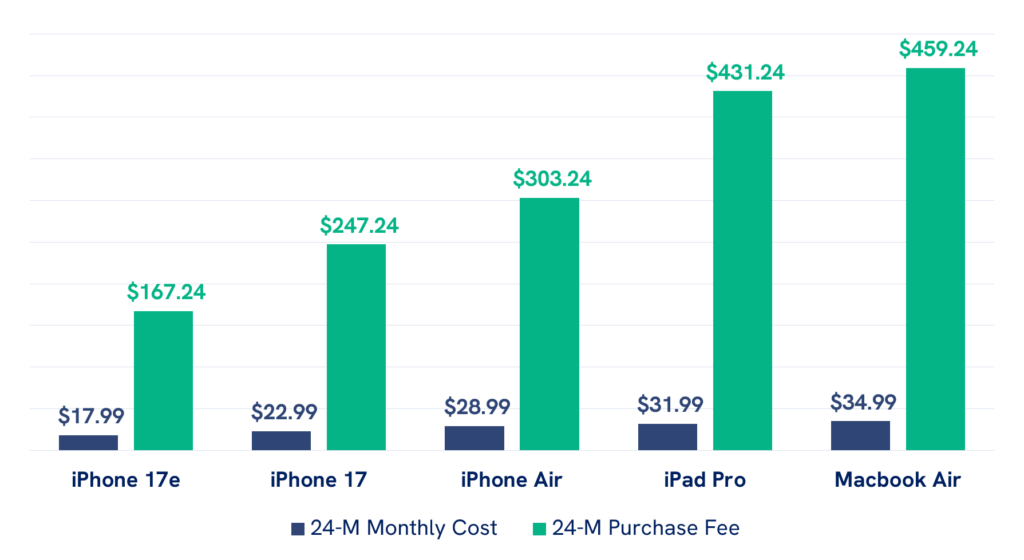
Across all “exit” options, Apple is slated to make back the full retail price, possibly with a bonus. By our calculations, customers who opt for a 12-month lease cumulatively pay on average 50 percent of a device’s retail price, those who go for a 24-month lease pay between 64 and 73 percent, and those on a 36-month lease pay as much as 75 percent of the retail price. If these customers then return their device, and Apple can then sell the used device for at least 25 to 50 percent of its retail price depending on the initial customer’s term, Apple will have made more profit than it would have without leasing. Importantly, customers who lease are losing out on this same resale and trade-in value by not owning their devices. One journalist calculated that renting access to a phone under Apple Upgrade could cost nearly $1,000 more than buying and later selling it over the course of five years.
What Happened to iPhone Upgrade?
What’s especially remarkable about Apple Upgrade is that it replaces a BNPL-style installment financing system the company already had. Apple previously offered an “iPhone Upgrade” program, which provided installment loans through Citizens Bank for customers to purchase (and eventually own) an iPhone. It also bundled Apple Care (insurance that covers repairs and theft/loss) into the monthly iPhone Upgrade payments. Under Apple Upgrade, users now have to pay as much as an additional $13.99 or more per month for this coverage.
The existence of the iPhone Upgrade program already told us that the cost of an iPhone exceeds what many Americans can afford. The rise of embedded finance and consumer debt everywhere echoes a similar story across the economy. Tens of millions of Americans are being forced into desperation finance: taking on medical debt, rental debt, BNPL debt for groceries, credit card debt for gas, and all kinds of other debt as prices for everything, especially the basics we need to get by, soar. Nearly two decades since its launch, the top-end price of an iPhone has grown by 233 percent—from $599 in 2007, to $1,149 in 2017, to now up to $1,999 in 2026 for the iPhone 17 Pro Max. Apple’s ability to charge those prices is in turn reinforced by its outsized market power in the smartphone industry. In a landmark antitrust lawsuit, the U.S. Department of Justice noted that Apple accounts for “over 70 percent of the performance smartphone market and over 65 percent of the broader smartphone market.” (The same filing provides an extensive account of the measures Apple took to establish its dominance, including restricting app development and distribution, marking Android users’ texts with green bubbles and eliminating encryption, and more.)
However, Apple’s pivot from offering a loan to buy your phone to a lease to rent your phone tells us something deeper about the shifting economics of one of the largest tech companies in the world, headquartered in the wealthiest country in the world, as it tries to market high-end electronics in an increasingly K-shaped economy.
The pivot toward phone leasing echoes a growing trend of “subscription-ification,” where companies are turning things that you previously paid for once to own, into an ongoing revenue obligation paid for access to the same thing. Companies are doing this to both basic and luxury goods and services, and the trend seems especially strong in the tech sector: Microsoft Office 365 is now a $99.99 per person, per year subscription; HP offers a $108 per year or more service to rent a printer and ink cartridges (with limits on the number of pages users can print and a $270 cancellation fee for the first two years); Toyota now charges $96 a year or more for drivers to use the remote-start feature on their key fobs; and Subaru now locks remote-start and other features behind a $67 or more annual subscription. In many cases, subscription-ification is happening as firms raise the prices of buying their wares outright, segmenting consumers into higher-income product buyers and lower-income renters. But in other cases, it could show that questionable practices historically reserved for predatory financing are trickling up into goods and services targeted toward middle- and upper-class Americans.
What’s the Catch?
The terms and conditions of the Apple Upgrade program contain a number of questionable to potentially predatory practices. Together, these provisions will help establish a permanent customer base that is locked into the latest Apple products and generates multiple additional revenue opportunities for the company (leasing, damage fees, and refurbishing and reselling) where it previously had one (selling).
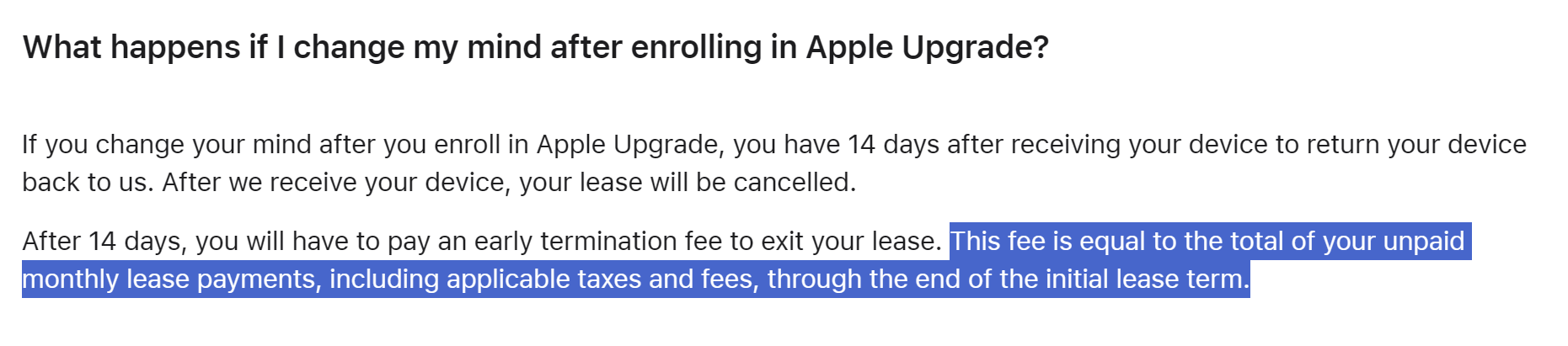
- Users who want to leave the Apple Upgrade program after 14 days face a hefty fee—equal to all the remaining payments on their lease. In Apple’s FAQs, it notes users who try to leave would face an “early termination fee” that is “equal to the total of your unpaid monthly lease payments, including applicable taxes and fees, through the end of the initial lease term” (see screenshot below). So if someone wanted to cancel and return an iPhone 17 after just 15 days of using it, they could be liable for $768 (the total paid for a 24-month lease). The natural implication is that after 14 days, users are far more likely to cut their losses and stick with the program than pay hundreds of dollars just to return the device early.
- Seemingly by design, users who want to keep their Apple device rather than upgrading at the end of their lease term face hefty purchase fees that are as much as 10 times what they normally pay each month. Customers who are pressed into using Apple Upgrade in the first place may not be able to afford these cost spikes and opt to roll into a higher monthly payment instead, ensnaring them in the program long-term.
This practice has a corollary in subprime mortgage lending. Before the financial crisis, subprime mortgages often included a final “balloon payment” that could be orders of magnitude larger than the typical monthly payment. Lenders knew that families would not be able to afford it, and Americans who couldn’t get another loan to pay it off would often lose their homes. The practice was so harmful that Congress passed a provision in the Dodd-Frank Act which effectively eliminated it from the market. Today, balloon payments are still common in predatory financial products targeted toward Americans who can’t afford conventional mortgages, including lease-purchase agreements and contracts for deeds. Like the final payment of the Apple Upgrade program, mortgage balloon payments force borrowers to either return the collateral (your home, your smartphone) or roll into a new loan or lease, trapping people long-term in debt.
- When users fall behind, they may be forced to return their device, pay off their entire balance immediately, or even get sent into collections. It’s been widely reported that three missed payments in a row would obligate a user to return their device or pay off the entire balance immediately (though the precise terms and conditions are not yet publicly available). Klarna notes that it would retry and “attempt to charge a backup payment on file” when a payment cannot be collected, which could subject customers to non-sufficient funds fees from a bank account provider. Klarna further notes that it can send missed payments into debt collection, which may eventually be reflected in users’ credit reports.
- Apple has programmed a mysterious debt collection feature that locks users out of their phones. In a beta version of iOS 27, Apple includes code for an authorized lender to restrict access to most apps and other core features on financed iPhones. Ostensibly, lenders may only turn on this “Restricted Mode” when users fall behind on their payments, but 9to5Mac reports that the code is programmed so that “the financing provider’s app decides when to lock the device based on its own policies.” Moreover, since Restricted Mode doesn’t suspend or modify App Store subscriptions associated with blocked apps, such subscriptions could keep billing even when the user’s access to the app has been blocked.
There’s also a precedent for this in subprime auto lending. Subprime auto lenders often include “kill switches” in their vehicles that interrupt the starter motor when the borrower is behind on payments. These devices can even turn off the engine while the car is on the road, and when the borrower is not actually behind on payments but the lender’s system glitches and wrongfully thinks they are. The Consumer Financial Protection Bureau (CFPB)—which the Trump Administration is trying its hardest to dismantle—sued one such lender for wrongly disabling vehicles at least 7,500 times when the borrower was not actually in default or was in communication about upcoming payments. While an iPhone is not literally a car, it can still be your only way of getting around in the age of rideshare and tap-to-pay, and it’s not hard to imagine how locking someone out of their phone could derail their professional, financial, and personal lives, and paradoxically imperil their ability to make back their missing payments.
Apple has publicly stated that Restricted Mode will not be used in connection with the Apple Upgrade leasing program. But the feature now exists—and it remains to be seen which lenders will use it.
- Users are required to return their devices in “good working condition, as determined by Apple.” If a device is damaged, Klarna maintains that “a damage fee may be charged” but does not publicly disclose what that fee is, based on our research so far (it’s possible the fee is stated in terms and conditions that are locked behind a Klarna login, more on that below). Unlike the iPhone Upgrade installment lending program, AppleCare is no longer bundled into monthly payments and costs as much as an additional $13.99 per month. The user is also responsible for the “full device cost” if it is lost or stolen.
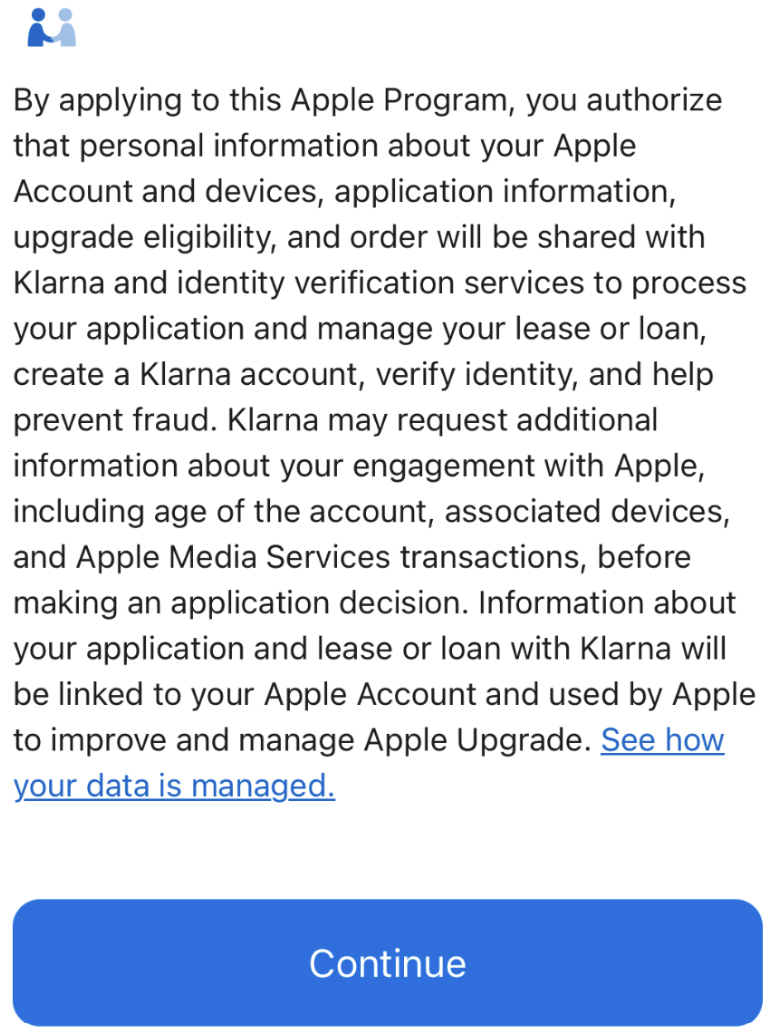
- Currently, access to basic information about the Apple Upgrade program is locked behind a Klarna login. For Apple customers to even see their final monthly payments after taxes and/or fees, they need to make a Klarna account and connect their Apple ID. In doing so, they are forced to consent to a range of data-sharing provisions stated in the Apple Upgrade Privacy Policy, but also the privacy policies of Klarna and WebBank. Klarna in particular collects vast swaths of information on its users which it may share with third-party companies and advertisers, including the user’s geolocation information, biometrics, internet browsing history, consumer preferences (including interests, hobbies, behaviors, aptitudes, etc.), mouse movements and keystrokes, and more.
The Financing Partner Matters
Apple has previously run into issues when launching consumer financial products in partnership with firms that were themselves first entering the space. In 2019, it launched Apple Card in collaboration with Goldman Sachs, an investment firm that had never before operated a credit card. The CFPB eventually ordered both companies to pay over $89 million for charging interest on payment plans that were represented as interest-free, deceptive marketing practices, not providing basic transaction dispute and customer service functions required of credit card companies under federal law, and other violations. In 2025, the Trump Administration terminated the order, including all compliance obligations, and waived most of the penalties.
In launching the Upgrade leasing program, Apple ditched a monthly installment loan program (financed by the brick-and-mortar Citizens Bank) that was much more in Klarna’s usual wheelhouse, to partner with Klarna on both companies’ first-ever leasing program. Over the last few years, Klarna has rapidly launched a range of financing products far beyond standard BNPL offerings, including “gift card” accounts, bank accounts, credit cards, savings accounts, and investing accounts.
Leasing is only the latest addition to Klarna’s already expansive product portfolio, which already charts some risky waters. Many of Klarna’s products are financed through WebBank, which has been sued by the Colorado Attorney General for engaging in “rent a bank” schemes—a strategy where lenders try to evade state usury caps by laundering their loans through banks and passing them off as the bank itself making such loans. Meanwhile, Klarna has been the subject of thousands of CFPB complaints documenting consumers’ problems with getting refunds, accessing funds, being charged unexpected fees and interest, and more. As Klarna adds scores of Apple users to its books with the Upgrade program, regulators should assess whether its capacity for compliance has kept up with the pace of its product expansion.
###
Jennifer Zhang is a Policy, Research, and Data Analyst at Protect Borrowers. She was previously a Director’s Financial Analyst at the CFPB, where she worked with the Student Loan Ombudsman’s office, the Policy Planning & Strategy team of the Director’s front office, and the Quantitative Analytics team of the Enforcement Division. This blog was also published on In Debt, a Protect Borrowers Substack.