What In The World Is Going On Here And What Policymakers Need To Be Asking
By Winston Berkman-Breen | August 20, 2026
The Trump Administration is continuing its assault against public service workers. First, it tried to unlawfully fire thousands of federal employees. Those wrongful terminations are still being litigated in courts. Then, it tried to weaponize the Public Service Loan Forgiveness (PSLF) program to punish teachers, nurses, librarians, first responders, and other public service workers who engage in activities that the administration opposes, like immigrant rights, gender affirming care, or diversity and inclusion. Protect Borrowers represented a coalition of local governments, nonprofit organizations, and public sector and educator labor unions to successfully sue and block that effort.
Now, the Trump Administration is surreptitiously clawing back credit toward PSLF that has already been earned and posted to public service workers’ accounts. This is happening in real time, and Department of Education (ED) officials have been slow to provide much-needed information to borrowers, but what is clear is that public service workers across the country are losing eligible time towards debt cancellation.
In this post, we will provide necessary history and context about the PSLF program up until this point, and then outline what we know about the ongoing PSLF credit theft, what we don’t know, and what questions policymakers should be asking to push back on these attacks on public service workers and ensure that the Trump Administration restores these borrowers’ hard-earned progress towards PSLF cancellation.
Congress created PSLF to help public service workers struggling with student loan debt.
Passed into law on a bipartisan basis in 2007, PSLF was created to provide loan discharge to public service workers with student loan debt in exchange for a decade of service in their communities or to our country. PSLF provides that borrowers working in public service fields—defined as work for a government or a 501(c)(3) nonprofit—can have the remainder of their federal student loans cancelled after 120 qualifying payments, the equivalent of 10 years. To be a “qualifying payment” each payment must be made 1) on the correct type of federal student loans, 2) pursuant to a qualifying payment plan, 3) while employed in public service.
One of the qualifying payment plans for PSLF is an Income-Driven Repayment (IDR) plan. Rather than setting monthly payments based on the size of a borrower’s loan, the IDR plans set monthly payments based on a borrower’s income. All of the IDR plans offer eventual loan cancellation after 20 to 30 years of enrollment. This cancellation aims to ensure that low-income borrowers whose monthly payments are so low as to not cover monthly accruing interest are not stuck in a life-long debt trap. Public service workers can benefit from the lower monthly payments under IDR, and access cancellation after only 10 years through PSLF.
Taken together, these programs are meant to ensure that borrowers can enter into critical but lower-paying jobs in the public sector without being burdened by their debt for their entire careers.
Both the PSLF and the IDR programs suffered from mismanagement and malfeasance by the student loan servicing industry for decades.
Although good on paper, both the PSLF and IDR programs were significantly undermined by lax oversight by ED officials and by deliberate sabotage at the hands of self-interested student loan servicers, the private companies contracted by ED to administer the federal student loan portfolio and programs.
For PSLF, servicers miscommunicated program requirements to borrowers. Servicers incorrectly told borrowers with ineligible loans or enrolled in ineligible payments plans (i.e., not IDR) that they were progressing toward cancellation for years; only for borrowers to learn that none of their time in public service would count. The results were devastating. By December 2018, over a decade after the program began and more than one year after the first borrowers should have been eligible for cancellation, the program had a 98 percent rejection rate. Even the government’s attempt to address some of these problems floundered. Five years after the initial data, the Temporary Expanded PSLF program (an expansion meant to address PSLF’s initial rejection rates) had its own 99 percent denial rate. At the time, ED’s own contractor estimated that by 2026 four of every five borrowers pursuing PSLF would still not have secured promised loan forgiveness through it. Underlying these statistics, millions of public service workers have been cheated out of their right to loan forgiveness guaranteed under federal law.
Clearly, PSLF wasn’t working.
At the same time, student loan servicers engaged in a well-documented practice called “steering,” wherein they directed struggling borrowers into forbearances and deferments rather than into IDR plans. Forbearances and deferments are short-term options during which no payment is due, but that are inappropriate for borrowers with longer-term affordability issues. However, they are much cheaper for servicers to implement.
Forbearances and deferments are not in the best interest borrowers with longer-term affordability issues for two reasons. First, they do not resolve the underlying unaffordability by, say, lowering a monthly payment the way that IDR would have, and instead only postpone unaffordable monthly payments. Second, neither is counted as a qualifying payment under the PSLF or IDR program, which means months spent in forbearance or deferment postpone cancellation under either program.
The harmful effects of servicer steering are well documented. For example, a March 2021 report we published with our colleagues at the National Consumer Law Center found that although IDR plans had been in existence for more than 25 years, over 4.4 million borrowers had loans 20 years or longer, and IDR plans only require 20 to 25 years of enrollment to qualify borrowers for cancellation, ED had only cancelled loans through IDR for 32 borrowers. This is largely attributable to servicers steering borrowers away from qualifying IDR plans for years at a time.
In response to industry misconduct and mounting pressure from advocates, ED began to correct these systemic failures and provide relief to PSLF and IDR borrowers.
Beginning in 2021, the Biden Administration announced two initiatives explicitly meant to restore credit toward PSLF and IDR that was stolen from borrowers due to servicer misinformation and steering. Both programs were explicitly remedial and intended to restore borrowers to the place they would have been were it not for servicers’ industry-wide misconduct.
First, in October 2021, ED announced the PSLF Waiver. Under the Waiver, ED would treat any time borrowers spent in an otherwise non-qualifying payment plan (i.e., not in repayment under IDR) as counting toward PSLF, as long as they maintained public service jobs, including the forbearance and deferment into which they may have been steered. The program also benefited borrowers who had been misled into believing their non-PSLF qualifying loans were eligible by allowing them to consolidate into a qualifying loan type (a Direct Loan) by October 2022, after which ED would finalize the restored credit, including for time prior to the loan consolidation. By the end of the Waiver and Biden Administration, 1,069,000 borrowers had received PSLF cancellation, up from only 7,000 before ED took action. Borrowers received restored credits through the Waiver but still had not reached the 120 threshold necessary for PSLF cancellation, which they can still earn through continued work in public service.
Shortly thereafter, in April 2022, in response to the well-documented evidence of servicer misconduct that pushed IDR relief out of reach for borrowers, ED announced the IDR Account Adjustment. Under the Account Adjustment, ED would treat any time that a borrower’s loan was in repayment or was in cumulative deferments or forbearances as qualifying payments toward IDR cancellation thresholds, even if the borrower was not actually enrolled in an IDR plan. This had the knock on effect of also qualifying any of those adjusted months as qualifying for PSLF. The Account Adjustment was automatically given to borrowers whose loans were held by ED, but borrowers whose older, legacy federal student loans were privately owned did not receive this relief. Like the PSLF Waiver, borrowers could take advantage of this program by consolidating their loans. The Account Adjustment consolidation deadline was June 30, 2024. The final Adjustment credits were awarded on January 16, 2025, in the last days of the Biden Administration. In total, 1,454,000 borrowers had their loans cancelled through IDR, up from just 32, and an unknown number of borrowers received credits on their accounts to help them reach the 240-300 payments (20 to 30 years’ worth) needed for IDR cancellation.
In addition to these substantive fixes, ED also made sure that borrowers had access to PSLF and IDR trackers on their account dashboards, so that individual borrowers could login at any time to check their status toward the 120 payments necessary for PSLF and the 240 to 360 payments necessary for cancellation under IDR. (The Trump Administration ultimately removed the IDR tracker in April 2025, foreshadowing this current mess.)
The Trump Administration may be clawing back ED’s remedial programs, at borrowers’ expense.
Beginning in August 2026, the Trump Administration quietly added a banner to borrowers’ accounts: “PSLF Qualifying Months of Employment Incorrect.” The banner explained that there was an error with the PSLF counts that ED was working to fix. In reporting on the issue, ED provided little information—citing “coding errors” described without any further information as a “misstep” by the Biden Administration that needed fixing—even as borrowers began to see unexplained drops in their PSLF counts. Although it was unclear initially whether these drops were part of fixing the underlying error and if borrowers’ credits would be restored, or if they are being permanently removed as part of ED’s “fix,” more recently borrowers have begun to receive “Qualifying Payment Reduction Update” notices, indicating that borrowers’ PSLF counts are being permanently reduced.

Hundreds of borrowers have taken to online forums to share information and their own stories. On Reddit, borrowers post about losing single months or even years’ worth of payments. Whereas some acknowledge that these months were months recovered through the PSLF Waiver or IDR Adjustment, others claim to have been in qualifying plans throughout their time in repayment, suggesting that the Trump Administration is clawing back credits beyond those previously adjusted by ED.
Borrowers are panicking. They have been working diligently in public service as educators, servicemembers, and healthcare providers on the premise that after 10 years of service their loans would be paid off. They’ve held up their end of the bargain, but now the Trump Administration seems to be reneging on its end.
Why this matters.
We still don’t know much, but based on what we do know, we’re sounding the alarm. The Trump Administration is altering borrowers’ loan records without any meaningful transparency. In doing so, they could be violating borrowers’ statutory rights by clawing back PSLF credits properly earned and awarded through the Higher Education Act, the federal law that governs the PSLF program.
Even if, as the administration claims but for which it has offered no support, the reductions in PSLF credits are the result of errors caused by the Biden Administration, ED has not clarified whether its position is that the awarding of credit was itself an error, or if the awarding of credit caused some other error. In either event, ED has not explained why clawing back PSLF credit and punishing public service workers in the process is the appropriate response.
Borrowers need independent oversight of ED’s handling of their accounts.
The current leadership at ED has already proven that it is unwilling or unable to conduct a thorough review or implement any necessary changes. A Government Accountability Office report earlier this year found that ED has ceased assessing its contracted servicers’ interactions with borrowers. Without this oversight, servicers have continued to run amok. For example, earlier this month, the student loan servicer MOHELA sent notices to an unknown (but large) number of borrowers incorrectly informing them that they were over 270 days delinquent on their payments. The problem? These borrowers have been in a special forbearance related to the SAVE plan for more than two years, during which time no payments were due, and so they could not possibly be late on their payments. The notices were sent in error. Maintaining accurate records is basically MOHELA’s whole job and it failed. Hardly confidence inspiring.
Even just this week, in a lawsuit brought by borrowers seeking to access affordable repayment plans, ED had to dramatically walk back a sworn statement it had submitted to the court.
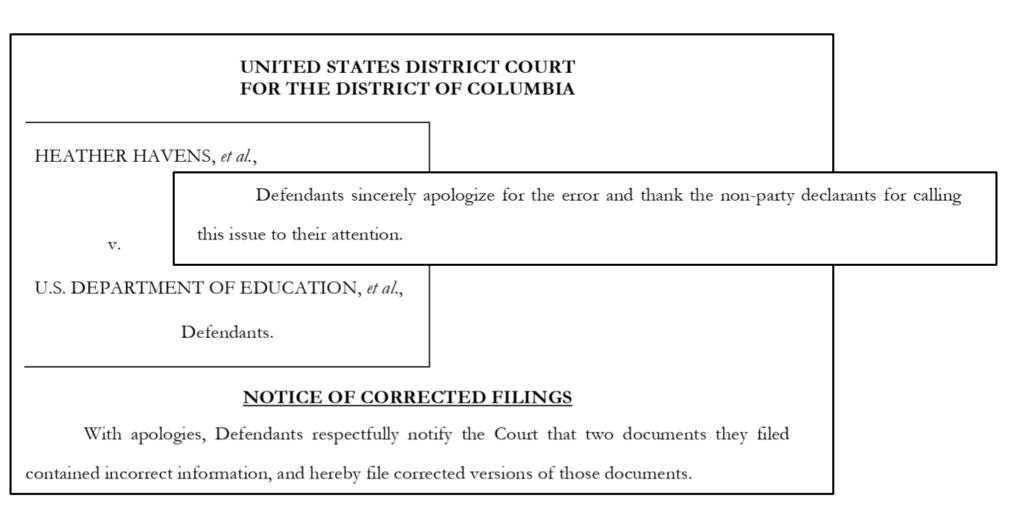
In doing so, ED essentially conceded that its staff didn’t know how to properly read ED’s own student loan recordkeeping system. If it was providing wrong information to a federal judge and only admitted to the error in the face of contested litigation, why should borrowers believe its public statements about these PSLF clawbacks?
Lawmakers and enforcement officials need to step up and start demanding answers on behalf of their constituents.
The Trump Administration has spent the last two years gutting ED. As a result, borrowers have been forced to navigate unprecedented chaos and confusion on their own. Enough.
Here are 22 questions that policymakers should be asking ED to set the record straight, understand what is going on, and help hold borrowers harmless in the process:
- Is ED taking PSLF credit away from borrowers to whom credits were already awarded, causing their overall PSLF credit count to drop?
- If ED is taking away PSLF credits, is this permanent or temporary? If it is temporary, when will borrowers’ credits be restored?
- On what basis is ED determining whether a specific month was credited toward PSLF or IDR in error?
- What are the “coding errors” ED cited as a justification for taking away credits?
- Is the process of taking PSLF or IDR credit away from borrowers complete?
- Does ED have plans to make any additional changes toward prior determinations of PSLF or IDR eligibility?
- What is ED’s statutory authority to revoke previously awarded PSLF credits?
- Did ED’s Secretary, Undersecretary, or Federal Student Aid COO review and sign any decision memo authorizing ED to revoke PSLF credits?
- How many borrowers have had their PSLF credits taken away?
- How many borrowers were sent notices about their updated PSLF credits?
- What is the average number of credits that have been taken away?
- What is the greatest number of credits that have been taken away from any individual borrower?
- Are borrowers affected by this reduction in PSLF credits associated with any one student loan servicer in particular?
- Has ED reinstated any borrower’s loans that were previously cancelled through PSLF on the basis that some of the credits used for the cancellation must be revoked? If so, how many borrowers?
- Does ED have any plans to reinstate any borrower’s loans that were previously cancelled through PSLF on this basis, or on any other basis? If so, how many borrowers?
- Has ED revoked any IDR credits during the same period as it has revoked PSLF credits?
- When does ED plan to restore the IDR credit counter to borrowers’ StudentAid.gov accounts?
- Will ED commit to holding individual borrowers harmless when it discovers errors in its own student loan data system that occurred due to no fault of the borrowers?
- Does ED consider PSLF credits awarded through the PSLF Waiver to be accurate and count toward the 120 payment threshold required for cancellation through PSLF?
- Does ED consider PSLF or IDR credits awarded through the IDR Account Adjustment to be accurate and count toward the 120 payment threshold required for cancellation through PSLF or the 240-360 payment threshold required for cancellation through IDR?
- Has ED revoked any PSLF or IDR credits that were not initially awarded through either the Waiver or Adjustment programs?
- Has ED had to pay its contractors additional funds to process the clawback of PSLF or IDR credits? If so, how much has ED paid?
###
Winston Berkman-Breen is Legal Director at Protect Borrowers. This blog was also published on In Debt, a Protect Borrowers Substack.